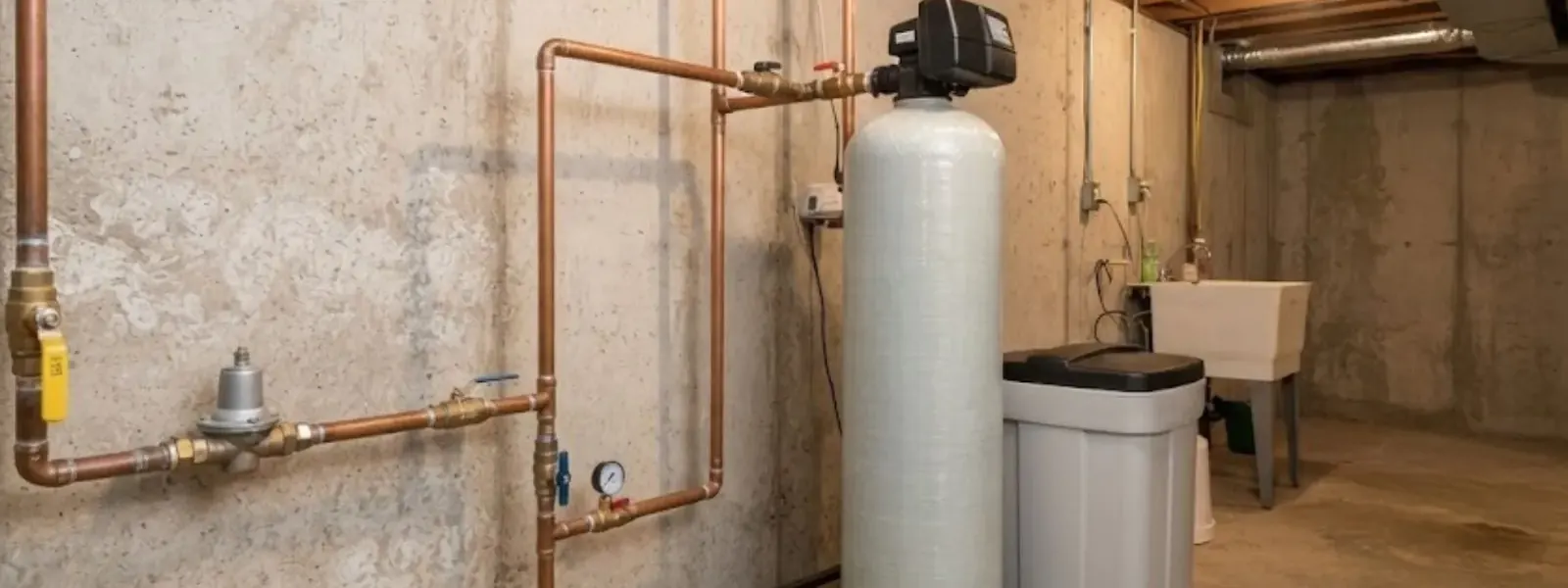
Does your home in Elmwood Park need a water softener? The honest answer starts with a test, not a purchase. Water in the Village comes from Lake Michigan, bought from the City of Chicago, treated and chlorinated before it reaches you. Whether it leaves scale in your pipes is something you can measure.
A softener, a filter and a reverse osmosis unit do three different jobs. We install all of them and service existing units, and we will tell you plainly when the right answer is to wait or to buy nothing.
Test your tap and read the Village water quality report first
Each year the Village puts out a water quality report, posted on the Public Works water page. It covers the water the Village buys, stores and pumps. It does not give you a verdict on your own pipes, and we are not going to quote a hardness number for the Village here, because the report does not state one for us to cite.
A simple hardness test strip from a hardware store, or a lab test, tells you what comes out of your tap. If the result is low, a softener will not help. If it is high and you see scale, a softener may be worth discussing.
How hardness shows up around the house
Mineral scale is a sign of dissolved minerals that leave a deposit when water evaporates or heats.
White crust on faucets and showerheads
Chalky buildup around spouts, aerators and spray holes.
Spotted glasses and dishes
Residue after the dishwasher runs.
Reduced flow over time
Scale narrows small openings first.
Water heater problems
Sediment collects at the tank bottom and a tank may run noisily. See water heater repair.
Soap that never seems to lather
A sign worth testing before you assume anything.
Softener, filter, reverse osmosis and sediment filter, side by side
These are different tools. Buying the wrong one is the most common mistake we see described.
| System | What it does | What it does not do | Where it goes |
|---|---|---|---|
| Water softener | Swaps hardness minerals for sodium or potassium using salt | Does not remove lead, chlorine taste or sediment | On the main line, usually in a basement |
| Whole-house sediment filter | Catches sand and rust particles | Does not soften | On the main line, before other equipment |
| Carbon filter | Reduces taste and odor from chlorine | Does not soften | Whole-house or under the sink |
| Reverse osmosis | Pushes water through a fine membrane at one tap | Slow, and wastes some water | Under the kitchen sink |
What a softener will not do
A softener does not remove lead and it does not remove chlorine taste. It is a mineral exchange device, not a treatment for contaminants. For questions about lead, see the Village's water service material inventory and its lead page. If you want to improve taste, a carbon filter is a better fit.
You may not need one: an honest look
A softener may help if
- Your test shows significant hardness
- You see scale on fixtures and in the water heater
- You can accept the salt and a drain connection
- You will maintain it with salt refills
Skip it, or try less, if
- Your tap tests low for hardness
- Your only complaint is taste or smell
- Your complaint is a single faucet's aerator
- You do not want another appliance to maintain
If the water is already treated and your test is low, we say so. A softener that does nothing useful is a cost with no return.
Ready to talk through your options?
Describe what you see at the tap, and a plumber will help you decide.
How a softener install goes
Choose the location
Near the main water line, a drain, and an electrical outlet, often in the basement or utility room.
Set up the bypass valve
A bypass lets water flow around the unit for service and keeps the house supplied if the unit is off.
Connect the drain
The unit sends rinse water to a floor drain or standpipe through an air gap.
Fill the brine tank with salt
Add the salt type the maker recommends and set the regeneration schedule.
Test the water
We check connections, flush the system and confirm flow at the taps.
Servicing an existing softener or conditioner
Many calls are about units already installed: a valve head that stopped cycling, a brine line that was cut during a remodel, a bypass handle broken by movers, or a tank with a salt bridge. We look at the unit before quoting, and tell you whether a repair or a replacement is reasonable.
If you bought a unit elsewhere, we install it. If you are buying a home, a plumber can look at the softener and the plumbing around it. Ask on the phone about your brand.
Under-sink reverse osmosis and whole-house filters
Filtration works best when it matches a specific goal.
Under-sink reverse osmosis
A small tank and faucet at the kitchen sink for drinking and cooking water. We install the supply tap, drain saddle and storage tank.
Whole-house sediment filter
A canister on the main line that catches grit. Filter cartridges need regular replacement.
Carbon filter
Reduces chlorine taste and odor. Check the maker's rating on the label.
Older houses and your pipes
Most homes here are 50 to 90 years old, so original galvanized or copper supply lines are often still in service. Adding a softener on old piping can reveal valves that will not close or a main line that needs work before we connect anything.
Because the Village is surveying water service line materials, owners should read the Village's notices. If your main line is old, ask about water line repair before spending on equipment.
Cost drivers in words
Price depends on the equipment you choose, the location of the main line, the drain connection, electrical outlet access and any pipe changes. We state the price before work starts. For other fixtures, see plumbing installation.
Softener and filter questions, no sales pitch
Yes, in most cases. Tell us the brand and size on the phone, and we will say what we need.
No. It addresses hardness minerals. For lead questions, consult the Village's lead information. For chlorine taste, ask about a carbon filter.
The Village's water quality report does not give us a number to quote, so test your own tap and read the Village report posted on its Public Works water page.
A small tank, a dedicated faucet, a supply connection and a drain connection under the sink. The membrane and filters need periodic replacement.
Yes, we can look at the unit and its connections, and tell you what we see. Ask on the phone.
We repair many brands, but some valve heads need parts we must order. Tell us the model and we will say plainly what is possible.
It can reduce scale buildup in the tank. It does not replace regular tank maintenance.
The Village building department is the office to ask, because the answer depends on the scope of the install.
Standards and sources: Work in Illinois follows the Illinois Plumbing Code (77 Ill. Adm. Code 890), and the Village of Elmwood Park building department applies those minimum standards locally. Licence guidance comes from the Illinois Department of Public Health, whose online lookup verifies any Illinois plumber.