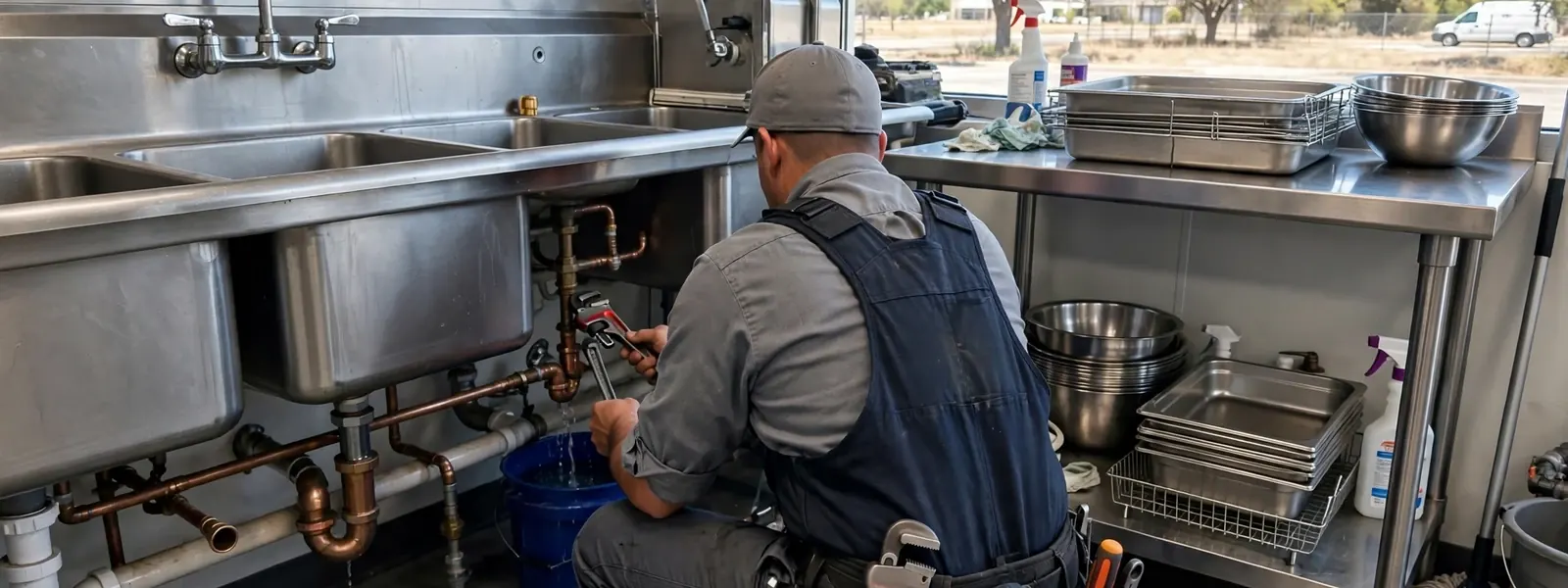
It is 9:40 on a Friday night. The floor drain in the back of the kitchen is bubbling, the dining room is full, and nobody wants to close. Our 24/7 line is open for commercial plumbing in Elmwood Park, and a licensed plumber will talk through what to do before anyone arrives.
Commercial plumbing is not residential plumbing with bigger pipes. Layouts are different, fixtures run all day, and downtime costs money. We work on restaurants, shops, offices and apartment buildings, and we plan the repair around the business.
A symptom table for a business in trouble
Use this to describe the problem on the phone. We ask the same questions on arrival.
| What you see | Likely cause | Shut off or stop |
|---|---|---|
| Floor drain bubbling or overflowing | Blocked branch or main line, or a backed-up trap | Stop dishwashing and sink use |
| Several restrooms backing up | Main line blockage | Close restrooms, keep customers away from wet floors |
| Water stains on the ceiling below | Leak above, supply or drain | Shut off the area's valve, protect stock |
| Low water pressure everywhere | Main valve, meter or supply line issue | Check the main valve and call |
| Toilet or urinal running constantly | Flush valve or flapper failure | Close the fixture stop |
Emergency plumbing at closing time, and what we do first
A business emergency is not a good moment for a lecture. We ask what is flooding, whether there is sewage, whether electrical equipment is wet, and whether the building can stay open. The answers decide the first step: isolate, protect, then repair.
After-hours work means a licensed plumber with a drain machine, a camera and the tools to cut and replace pipe. We explain the plan and the price before work starts, then fix the problem or stabilize it so the doors can open on time.
Backed-up floor drain or restroom outage?
Call the 24/7 line. A licensed plumber will tell you what to shut off.
Business types we plumb in and around the Grand Avenue corridor
Our office is at 7508 W Grand Ave, on the Grand Avenue commercial corridor, so many of the businesses we serve are close by.
Restaurants and kitchens
Floor drains, three-compartment sinks, dish machines and grease-laden lines get clogged easily. A restaurant kitchen on Thatcher or Grand needs a plan that works around service hours.
Shops and storefronts
Small retail often has a single restroom and a mop sink. When it goes down, the store may have to close. We prioritize getting it back.
Offices and clinics
Restrooms, break room sinks and water coolers. Leaks above ceilings damage computers and records, so shutting off the right valve quickly matters.
Multi-unit buildings
About half of the housing in Elmwood Park is two-flats, 3 to 4 unit buildings and larger apartments, so many of our calls come from landlords and building managers.
For landlords and property managers: a call checklist
If you manage several buildings, the more we know on the first call, the faster we can send the right tools.
Have these ready
- Address and unit. Include which floor and which fixtures are affected.
- Who can authorize the work. Tell us the owner or manager who can approve a price.
- Access. Who has keys, and when can a tenant be reached?
- Paperwork. If your company needs a work order or a specific invoice format, tell us on the call and we will say what we can do.
- Other units affected. A blockage at one unit may be a stack problem, so tell us about neighbors.
Floor drains and restroom fixtures in daily use
Floor drains collect water but they also collect debris. A drain that has not been flushed in months may have a dry trap that lets sewer gas into the room. Pouring water into a seldom-used drain restores the seal.
Commercial toilets and urinals use flush valves, not tank flappers. They need clean water, steady pressure and periodic service. A fixture that runs constantly wastes water, and a toilet that clogs repeatedly points to a main or branch line problem. See drain cleaning and sewer line cleaning for the methods we use.
Grease traps and interceptors: what we handle and what we do not
A grease trap is a tank that catches fat before it enters the sewer. Pumping a full trap is usually a hauling job done with a vacuum truck. Our plumbers handle the plumbing around it: clearing lines that feed it, finding why it backs up, and repairing or replacing fittings and baffles.
If you need the tank pumped, ask us on the phone whether we do it for your size of trap. We will tell you plainly, and if it is outside our work, we will say so rather than leave you waiting.
Backflow prevention: testing and repair, hedged honestly
A backflow preventer is a valve assembly that keeps dirty water from flowing back into the clean supply. Required testing, and who can do it, is set by the local water authority. Ask us on the phone whether we can test or service your particular assembly.
Repair or replacement of a failed assembly is plumbing work, and we can talk through it. If your utility sent a notice, read it, and tell us what it says so we can answer correctly.
Keeping a business open during a repair
Isolate the problem
We close the valve that serves the affected area, so the rest of the building keeps water.
Protect people and stock
Wet floors, electrical equipment and food storage come first.
Clear or repair
A drain machine for a blockage, a camera to find the cause, or a cut-and-replace for a failed pipe.
Restore and report
We test the fix and tell you what we found, so you can plan any follow-up work.
What drives the price of a commercial job
Price depends on access, hours, pipe size and material, the type of equipment needed, and whether permits or inspections are part of the work. We give a clear price before work starts, and we separate emergency stabilization from larger follow-up repairs.
If a leak is hiding in a wall or under a slab, a leak detection visit may come first. New construction and bids are a different conversation, so call and describe the project.
Commercial plumbing questions from local businesses
Yes. Businesses can reach a live plumber after closing, on Sundays and on holidays, and same-day visits are booked when the schedule allows. A promised minute would be a guess, so we spend the wait telling you which valve to close and what to cover.
Yes. Tell us who authorizes the work, who has access and what paperwork your company needs. We explain what we can provide.
Ask us on the phone about your trap size. Plumbing around a trap is ours. Pumping is often a separate hauling service, and we will say so plainly if it is not work we do.
Required testing is set by the local water authority. Call us with your notice and device details, and we will say whether we can test it. We can talk through repair or replacement of a failed assembly.
Often, with methods suited to the building. We use moisture meters and listening gear, and may recommend a longer survey. Tell us what you see.
Call and describe the project. We will say honestly whether it is the type of job we take.
Sometimes. If the problem can be isolated, we work around service. If not, we explain the shortest closure.
Commercial jobs are often reviewed more closely than residential ones. Put the question to the Village building department with a description of the work, and our plumber can help you word it.
Standards and sources: Work in Illinois follows the Illinois Plumbing Code (77 Ill. Adm. Code 890), and the Village of Elmwood Park building department applies those minimum standards locally. Licence guidance comes from the Illinois Department of Public Health, whose online lookup verifies any Illinois plumber.