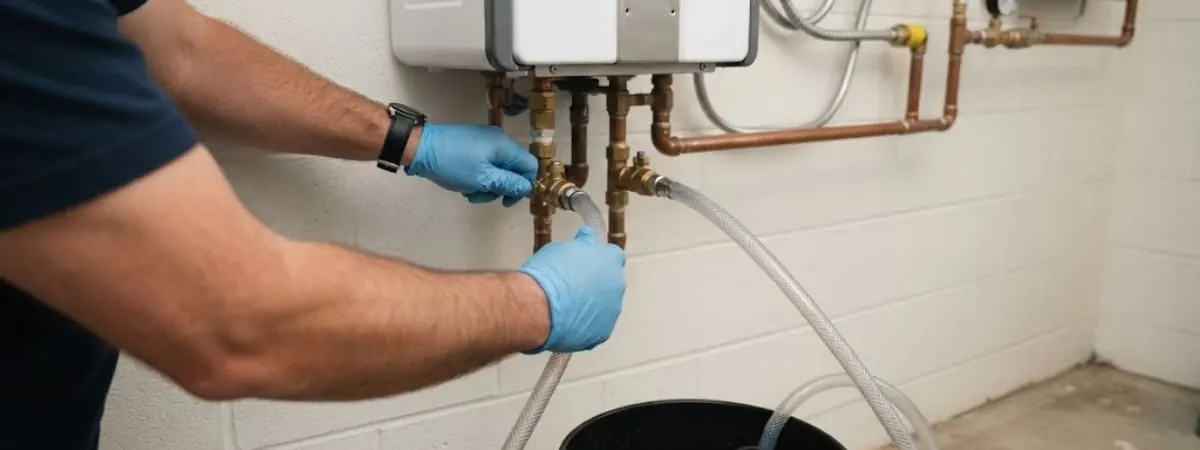
A tankless water heater heats water only when a tap opens, using a burner or electric elements inside a compact box. That is why tankless water heater service in Elmwood Park is mostly about what the unit needs from the house: gas volume, venting, or a strong electrical service.
We install tankless units, repair them, and flush the scale that builds up inside the heat exchanger. If your unit is flashing a code or the water goes cold midway through a shower, this page tells you what is likely happening. A failed old tank is covered under water heater repair.
Does a tankless unit suit your house?
The unit is only half the equation. Gas models need a large enough gas line and meter, and the vent must carry exhaust outside. In older homes the existing gas pipe may be sized for a small tank, not a unit that fires hard for a few minutes.
Electric models draw a lot of power, and a licensed electrician must assess the panel and wiring. We do not give electrical specifications, because the right answer depends on your service capacity and the unit chosen.
Tankless symptoms and what to do about each
Most complaints fall into three buckets, and the fix is different for each one.
| What you notice | Likely cause | What helps |
|---|---|---|
| Hot, then a cold burst, then hot again | The cold-water sandwich: water already in the pipes arrives after the unit shuts off and restarts | Wait a few seconds, check flow rate, consider a recirculating line or small buffer tank |
| Beeping and a code on the display | Ignition, flame sensor, venting, flow or temperature fault | Read the code, check vent and gas, clean sensors, repair or replace the failed part |
| Water loses heat over months | Scale on the heat exchanger | A descaling flush with a pump and approved solution |
| Unit shuts down in cold weather | Frozen condensate line or vent restriction | Insulate or reroute, clear the drain |
| Low flow at the tap | Clogged inlet screen or scale in the exchanger | Clean the screen and flush the unit |
How a descaling flush works
Isolate the unit
We shut off the gas or power, close the supply valves and open the service ports.
Circulate solution
A small pump moves a descaling solution through the heat exchanger for a set time.
Rinse and clean
We rinse the unit, then clean the inlet filter.
Test and record
We fire the unit, check the temperature and flow, and clear any scale-related faults.
Unit flashing a code?
Describe the display and the symptoms and a plumber will advise on the next step.
How often to flush
A yearly flush is the common rule of thumb, and it matters more where the water leaves mineral deposits. Hardness is not stated in the Village water report, so if you are unsure, check the report or test your tap. A flush costs far less than a failed heat exchanger.
When tankless is not worth it
A good fit
- A large household with long, heavy hot water use
- A home with a gas line and vent that can be upgraded
- Someone who wants to gain floor space
- A plan to flush the unit yearly
A weak fit
- A small household with short, scattered use
- A line too small and costly to enlarge
- No easy way to vent a high-output burner
- A panel that cannot carry an electric model
A standard tank is still the simpler path in many homes. Read about planned water heater installation to compare.
Repairs we handle on tankless units
Some jobs belong to the manufacturer, and some do not. These are the ones a plumber can usually finish on site.
Ignition and flame faults
Igniter, flame rod and sensors that fail or get dirty.
Venting problems
Blocked, cracked or poorly pitched vent pipes.
Flow and temperature issues
Inlet screens, flow sensors and mixing issues.
Leaks
Fittings, isolation valves and condensate lines. A leaking heat exchanger usually means replacement.
Isolation valves
If your unit was installed without service valves, we can add them so a flush is possible.
Cold weather and older basements
A winter low of minus 23 F at O'Hare in January 2019 showed how hard Chicago-area cold can hit. Condensate lines and exterior vent terminations are the parts of a tankless unit most exposed to that kind of freeze.
With a median home built around 1955, many Elmwood Park basements carry older gas piping and tight chimneys. A gas odor anywhere in the house means getting outside and phoning the utility or 911 before anything else.
Pricing without surprises
We do not name a price for a tankless job before a visit. For installs, gas line size, vent length, the unit's capacity and whether electrical work is needed drive the cost. For repairs, the failed part and access decide it.
You get the price before work starts. If a tank swap is more sensible, we say so, and you can read more at water heater replacement.
Tankless questions answered for Elmwood Park homes
We repair them. We diagnose error codes, clean or replace sensors and igniters, clear vent and condensate problems, and flush scale. When a heat exchanger has failed, we explain replacement options honestly.
Codes differ by brand, but they usually point to ignition, flame, venting, flow or temperature. We read the code, test the part it names and fix the cause.
It is the short blast of cold water between two hot spells, caused by water sitting in the pipes while the unit shuts off and restarts. Adjusting flow, using a recirculating line or adding a small buffer tank can help.
Yearly is a common guideline. Hard or mineral-rich water can call for more. If you have never flushed yours, tell us when you call.
It depends on gas supply, venting and electrical service. We assess these on a visit and tell you what is needed before you commit.
Yes. Wiring and breaker capacity require a licensed electrician, and your panel's capacity decides whether an electric unit is practical.
We work on most common brands at the plumbing level. Brand-specific sealed components may need the manufacturer, and we will tell you if yours does.
Standards and sources: Work in Illinois follows the Illinois Plumbing Code (77 Ill. Adm. Code 890), and the Village of Elmwood Park building department applies those minimum standards locally. Gas smell guidance comes from Nicor Gas: leave the building, then call the gas utility and 911 from outside.