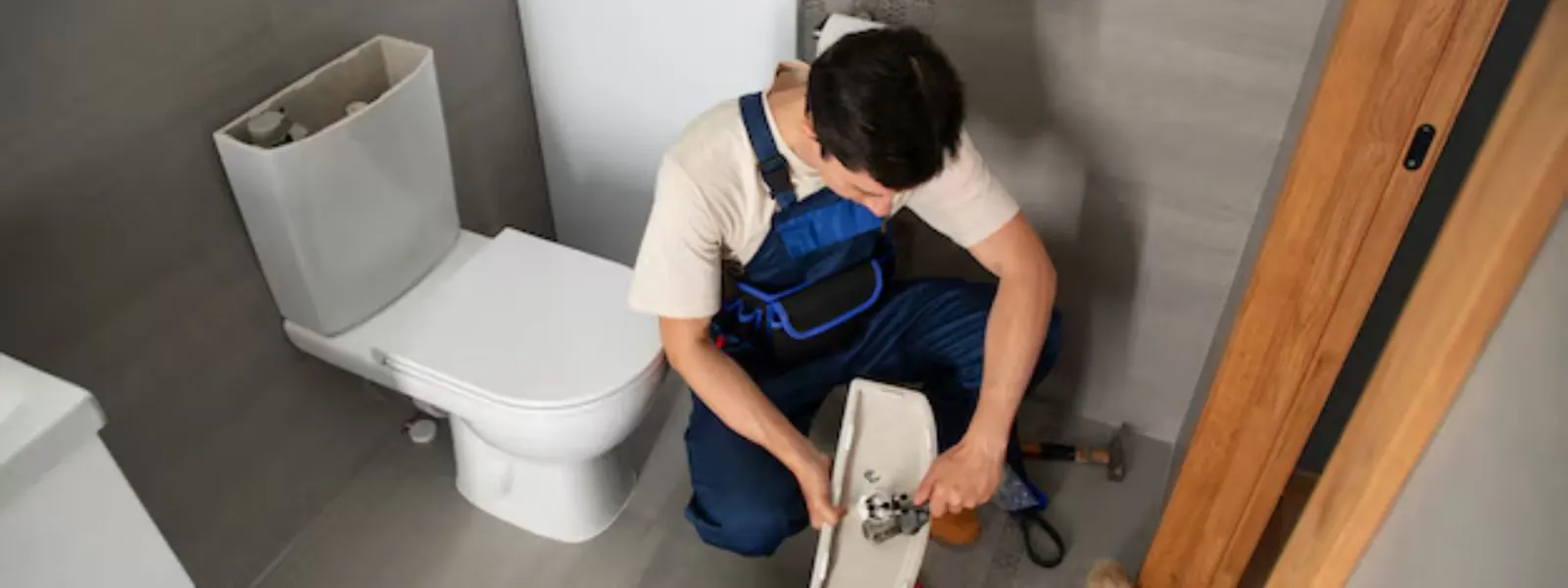
The water is rising toward the rim, or it is seeping across the bathroom floor, and it is two in the morning. Our 24/7 line is open for exactly this. While you wait, close the small valve on the wall behind the bowl by turning it clockwise, and lift the tank lid to hold the float up if you cannot reach the valve.
Toilet repair in Elmwood Park covers everything from a worn flapper to a failed wax ring, a loose flange, a cracked bowl or a full replacement. Most fixes are small and fast once someone finds the real cause, which is often not the part you suspect.
Five things a toilet does before it fails for good
Toilets rarely die without warning. The bowl gives small hints for weeks, and reading them early is the difference between a quick part swap and a wet ceiling in the unit below.
It runs, then stops, then runs again
A flapper that no longer seals lets tank water creep into the bowl, so the fill valve keeps topping it up. That quiet trickle shows up on your water bill.
The base rocks or the floor feels soft
A bowl that moves has lost its grip on the flange. Water that escapes at the base can soak the subfloor long before you see a puddle.
You need to jiggle the handle
A worn lever, a stretched chain or a flapper that sticks open all feel the same from your side of the tank.
Slow flush with a weak swirl
Mineral buildup in the rim jets and a partly blocked trap both turn a strong flush into a lazy one.
Hairline cracks or sweating that never dries
A crack in porcelain does not heal. A tank that drips from the outside may only be condensation, but a bowl seam that weeps is a replacement conversation.
What lives inside the tank, in plain words
Lift the lid and you will see only a handful of moving parts. Knowing them helps you describe the problem on the phone, and it helps you judge whether the fix we propose makes sense.
Our plumbers carry common fill valves, flappers, flush valves, handles, supply lines and wax rings on the truck, so many repairs finish on the first visit. Odd brands and older one-piece models sometimes need a part ordered, and we tell you that before we start.
- Fill valve: refills the tank after each flush and shuts off at the float. When it sticks, the toilet hisses or never stops filling.
- Flapper or flush valve seal: the rubber door at the tank floor. Old rubber goes soft and leaks silently.
- Handle and chain: a tiny lever that lifts the flapper. A kinked chain is a ten minute fix, a corroded arm needs a new handle.
- Supply line and shutoff valve: the braided hose and the wall valve. A valve that will not close is its own repair.
Repair the toilet or replace it? A quick decision table
A good plumber will not push you toward a new toilet when a small part would do, and will not patch one that is finished. Here is how we usually sort it.
| What you see | Usually means | Usual answer |
|---|---|---|
| Constant running | Worn flapper or fill valve | Repair in one visit |
| Water around the base | Failed wax ring or loose bolts | Reset the toilet on a new seal |
| Rocking bowl | Flange not holding the closet bolts | Repair the flange, then reset |
| Crack in the bowl or tank | Porcelain damage | Replace the toilet |
| Repeated clogs in a very old model | Low-flow design, worn trap | Replace with a modern siphon-jet bowl |
When a toilet clog is really a main line problem
One toilet that will not drain is usually a local blockage, and a closet auger or a hand plunger on the bowl clears it. If the bathtub gurgles when you flush, the sink bubbles, or several fixtures back up at the same time, the trouble sits further down the line.
That points to a drain or sewer blockage, not a toilet repair. We switch methods right away and use a drain machine, or a sewer camera when the cause is unclear. Our drain cleaning service and sewer line cleaning pages explain what that looks like.
Toilet leaking onto the floor right now?
Close the wall valve, lay towels, and call. We take the 24/7 line seriously.
Overflowing toilet: what to do first
A few calm minutes of prep reduces damage and saves time on the job.
Do these in order
- Stop the water. Turn the wall valve clockwise. If it spins loosely or leaks from the stem, shut off the whole house at the main valve instead.
- Do not flush again. Every flush into a blocked trap sends more water to the floor.
- Keep people off wet floors near outlets. Water and electricity do not mix. Switch off the bathroom circuit if the water has reached an outlet or a fan.
- Clear the space around the bowl. Move rugs, scales and cabinets so we can reach the closet bolts.
- Note what happened. Did it start after a flush, after a clog, or overnight? That sequence tells us where to look.
Toilets in Elmwood Park's older buildings
Most homes here are 50 to 90 years old, and about half the housing stock is made of two-flats, 3 to 4 unit buildings and larger apartments, so a toilet problem often belongs to a tenant, a landlord or both.
Old cast iron and clay behind the wall
Original drain lines are common in houses of this age. A closet flange on a cast iron stack can be rusted or broken, which is why a leaking base sometimes needs more than a new wax ring.
Several units on one stack
In a multi-unit building, a toilet that keeps backing up may be sharing a vertical stack with others. Tell us which units are affected and we check the shared line first.
Landlords and tenants
Tell us who authorized the repair and whether a unit manager will meet us at the door. We can then time the visit so nobody is waiting around.
How a toilet replacement goes, start to finish
Shut off and drain
We close the wall valve, flush the tank empty and sponge out the bowl.
Pull the old toilet
We lift it off the flange, inspect the floor for soft spots, and haul the old unit away.
Check the flange
A flange that sits too low, too high or cracked gets repaired before anything new goes on top.
Set the new bowl
A fresh wax ring or gasket, new closet bolts, level and snug but not overtightened.
Test and clean up
We run several flushes, check every joint with a dry tissue, and leave the bathroom clean.
What changes the price of a toilet job
We give a clear price before work starts, and it is built from a few honest factors. Parts and labor for a flapper are not in the same league as a flange repair under the floor, and a new bowl depends on the model you pick.
A second pair of hands, difficult access in a tight bathroom, a rotted subfloor or a corroded shutoff valve that must be replaced all add time. A fixed price is stated up front so a single surprise never becomes a second one. For larger remodel work, see plumbing installation.
Toilet questions we hear around Elmwood Park
Yes, any hour. A person answers the line, and a same-day slot goes to you whenever one is open. Nobody can honestly name an arrival minute in advance, so we begin by talking you through the wall valve over the phone.
A toilet that runs when nobody is using it is usually leaking water from the tank into the bowl. Because it can do that around the clock, the loss adds up on a metered bill. A new flapper or fill valve is typically the fix.
Water at the base or a faint sewer smell points to the wax ring. A cracked bowl, a damaged tank or a persistent weep from a seam points to replacement. We check the flange and the floor either way, because a bad flange ruins a new seal.
Yes. A replacement includes removing the old unit, setting the new bowl on a fresh seal and testing it. You choose the model, or ask us to supply a common one. The price is stated before we begin.
Plumbing connections, shutoff valves and water lines for those fixtures are ours to handle. Electronic parts such as heaters, spray pumps and control boards belong to the manufacturer, and any electrical wiring needs a licensed electrician. Ask us on the phone about your model.
The Village decides that, and the answer shifts with the scope of the work. Call the building department with your details. Swapping a bowl in place and rerouting a drain are very different projects.
Standards and sources: Work in Illinois follows the Illinois Plumbing Code (77 Ill. Adm. Code 890), and the Village of Elmwood Park building department applies those minimum standards locally. Backup and flood guidance comes from the Metropolitan Water Reclamation District flood resource guide, which advises keeping only waste and toilet paper going down the toilet.