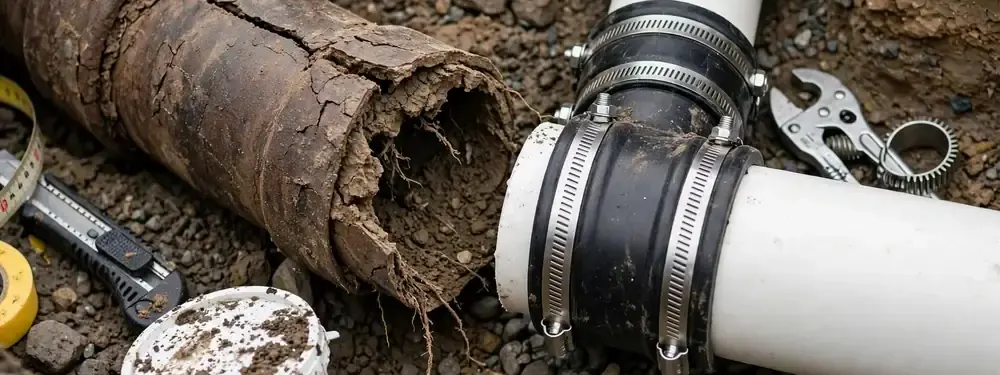
If sewage keeps coming up and a cable only buys a few days, the pipe itself may be broken. Our 24/7 line takes these calls at night and on weekends. Until we are there, stop using water, do not flush, and keep people away from wet floors, outlets and appliances.
Sewer line repair means fixing the pipe that carries waste from your house to the street sewer, whether by replacing a short section, lining the pipe from the inside, or replacing the run. In Elmwood Park, where most homes are 50 to 90 years old, the pipe is often clay tile or cast iron that has aged.
When sewage keeps returning, the pipe may be broken
A line that clogs once is a cleaning job. A line that clogs in the same place again and again, or one that backs up soon after being cleared, is a candidate for repair. The cable is clearing the symptom while the pipe keeps catching waste.
Signs that point toward a pipe problem:
- The same clog returns in weeks, in the same fixtures
- The camera or cable stops at a sag, an offset joint or a break
- A sunken strip or soggy patch in the yard along the line
- A sewer smell in the basement or yard that keeps coming back
- Roots in the line every time it is cleaned
We start with a camera inspection so the repair matches what is actually down there. A line that only needs clearing may be a hydro jetting job instead.
Camera confirmation before anyone digs
Find the entry point
We locate a cleanout or other way into the line, since a camera needs access to run.
Run the camera
A sewer camera on a flexible cable travels the line, showing joints, cracks, roots, sags and breaks on a screen.
Mark the location
A locator tracks the camera head from above ground, so we know the depth and position of any damage.
Walk through the findings
We show what the camera saw and what it means, then lay out the options in plain terms.
Spot repair, pipe lining or full replacement
The right repair depends on how much of the pipe is bad, how deep it lies and what is on top of it.
| Method | Fits when | Trade-offs |
|---|---|---|
| Spot repair | One short bad section, such as a broken joint or crushed piece | Needs a dig at that point, and the rest of the old pipe stays |
| Pipe lining (trenchless) | Cracks or root entry in a pipe that is still round and in place | Cannot fix a collapsed or badly offset pipe, and reduces the bore slightly |
| Trenchless replacement | Long failing runs where a new pipe can be pulled in | Needs entry and exit points, and not every pipe layout suits it |
| Open-trench replacement | Collapsed, bellied or heavily damaged pipe | The most disruption to lawns, driveways and landscaping |
Think the pipe is broken, not just clogged?
Call the 24/7 line and describe how often it has backed up. We will say whether a same-day camera visit is open.
Cast iron and clay tile: how old sewer pipes fail
Cast iron
- Rusts and scales from the inside, narrowing the bore
- Can flake into layers and crack at joints
- Heavy and often found under slabs and in basements
Clay tile
- Made in short lengths, so there are many joints for roots to enter
- Can crack or shift with soil movement
- Common in older underground runs to the street
Nearly 3 in 10 homes in the village were built before 1940, and about 77 percent before 1970, so these materials are often the ones we meet. Roots are the usual culprit in clay, and lining or replacement is how that gets fixed for good.
Digging means calling 811 first
Illinois law requires calling JULIE at 811 at least 3 days, and no more than 10, before you dig. The call costs nothing, and the locates last 25 days. Utilities do not mark a private sewer lateral, so our plumbers locate that line themselves.
Who owns the pipe, and who signs off the work
The owner is usually responsible for the sewer lateral on their own property, though you should check with the Village for how that applies to your address. The street sewer is a Village matter.
What a given repair needs from the Village depends on the work, so the building department is the place to ask. It requires plumbers to hold a State licence, insurance and a bond, and inspections need two working days notice. Any plumber's licence can be checked on the Illinois Department of Public Health lookup.
What moves the price of a sewer repair
We give a clear price before work starts. The big drivers are how much pipe is bad, how deep it is, what sits on top (lawn, driveway, slab or garage), the pipe material and size, and whether the Village needs a permit or an inspection. Lining and digging cost differently, and neither is automatically the cheaper path.
If the line only needs cleaning now, sewer line cleaning may be all you need for the moment, and the camera will tell us.
Sewer repair questions from property owners
Yes, and a broken pipe with sewage rising counts as urgent. The first visit is about getting waste moving and the house safe, and the repair gets planned once the camera has shown where the pipe failed. Same-day appointments are available when the schedule allows, with no arrival time promised.
Neither is always better. Lining avoids a large dig but needs a pipe that is still in place and round. A collapsed or bellied pipe usually has to be replaced.
We camera the line before recommending a repair, and we explain what is included when you call. You will have the price before work starts.
Sometimes. It depends on the pipe, its condition and where we can get access, and the camera answers that. Ask us on the phone and we will say honestly what is likely.
That depends on the method and the length. A spot repair is quicker than a full replacement. We tell you in advance whether your plumbing will be off and for roughly how long.
Rules differ from one job to the next, so put the question to the building department at the Village. We can describe the work so you ask it precisely.
The lateral serves your property, so it is usually the owner's. Check with the Village about your address, since rules and the exact point where responsibility ends can differ.
Standards and sources: Work in Illinois follows the Illinois Plumbing Code (77 Ill. Adm. Code 890), and the Village of Elmwood Park building department applies those minimum standards locally. Backup and flood guidance comes from the Metropolitan Water Reclamation District flood resource guide, which advises keeping only waste and toilet paper going down the toilet.