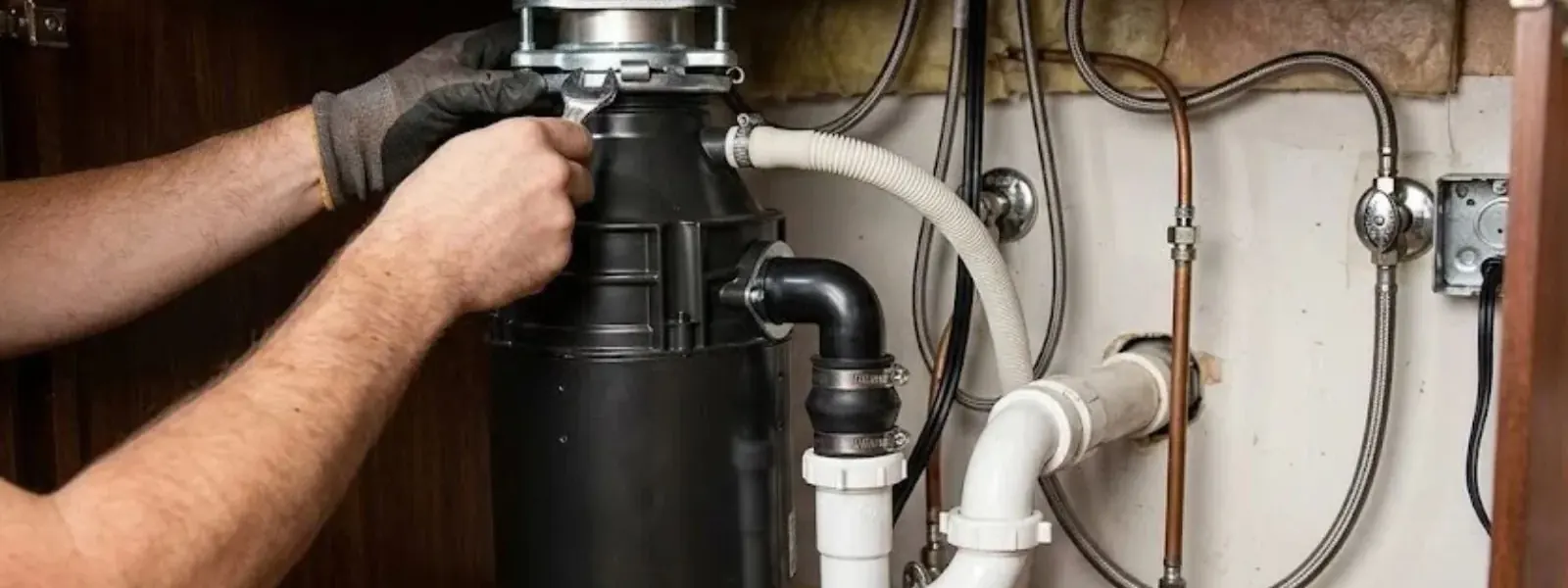
Short answer: do not put your hand in it. If the disposal hums and will not spin, or the sink is draining slowly and the cabinet is wet, turn the switch off, and unplug the unit or switch off its breaker before anything else. Our 24/7 line is open for disposal problems in Elmwood Park.
A garbage disposal is a small grinder bolted under the sink drain, with a motor below and a drain port that carries the waste into the trap. Most failures are a jam, a leak at a seal or flange, or a unit that has simply worn out.
Emergency triage for a jammed or leaking disposal
Is the switch off and the power cut?
Wall switch off first. If you can see an outlet or plug under the sink, unplug it. A hardwired unit needs its breaker turned off.
Does it hum, click or stay silent?
Humming means the motor has power but the blades are jammed. Silent usually means a tripped reset or a dead circuit.
Where does the water appear?
A drip from the top is the flange. A drip from the side is the dishwasher hose or a drain connection. A drip from the bottom usually means the housing has failed.
Does the sink drain on its own?
If water sits in the basin, the problem may be the trap or drain line beyond the disposal, not the unit.
What each sound or symptom tells us
Disposals do not fail at random. Each symptom points at a specific part.
Loud hum, no spin
A hard object or stuck blade. Many models have a hex socket on the bottom for turning the shaft by hand, once the power is off.
Dead silence
A tripped overload reset, a tripped breaker, or a failed motor. The red reset button on the bottom is the first stop.
Grinding with metal rattle
A spoon, bottle cap or fork has fallen into the grind chamber. Fish it out with tongs, never fingers.
Water pooling at the bottom
Seals between the upper and lower housing wear out. That kind of leak means the unit is finished.
Foul smell that returns
Food residue builds up on the splash guard and baffle. A cleaning may help, but a persistent smell can mean a partly blocked drain line.
Repair it or replace the disposal
Repairing fits when
- A jam can be freed without damage to the motor
- The leak comes from a loose drain connection or a hose
- The reset button restores power and it runs normally
- The unit is fairly new and the housing is dry
Replacing fits when
- The housing leaks from the body
- The motor hums, resets and trips again
- Rust shows near the bottom plate or the seams
- The disposal is old and repairs would cost more than a new one
If you already bought a new disposal and could not finish the swap, tell us. We can hang it, connect the drain, reattach the dishwasher line and test it. Ask us on the phone which common brands we can supply the same day when available.
Cabinet filling with water from the disposal?
Turn off the unit, close the valves under the sink and call.
The dishwasher connection most people forget
Many dishwashers drain through the disposal. A small knockout plug inside the disposal's side port must be removed when a dishwasher is connected, and if it is left in place the dishwasher stops draining. That is a common reason a new install backs up into the dishwasher.
When a disposal is replaced, the dishwasher hose is reconnected with a clamp, and the line should rise in a high loop under the counter so dirty water cannot flow back. We check that loop on every job.
What should never go down a disposal
A disposal handles soft food scraps with plenty of cold water. These items cause most of the service calls we describe above.
| Do not grind | Why it causes trouble |
|---|---|
| Grease, oil, fat | Cools in the trap and lines, then hardens into a plug |
| Coffee grounds | Pack into a paste that settles in the trap |
| Pasta, rice, potato peels | Swell with water and turn into starchy sludge |
| Fibrous peels, celery, corn husks | Wrap around the shredder ring |
| Bones and fruit pits | Too hard, may jam the impeller |
| Utensils, bottle caps, glass | Damage blades and the grind ring |
The electrical part is not a plumber's job
Connecting a disposal to a plug or hardwired circuit, adding an outlet under the sink or a new wall switch is electrical work. We handle the plumbing side. For any new circuit, outlet or switch, hire a licensed electrician.
Is it the disposal, or the drain beyond it?
Water that backs up into the sink even with the unit off usually means a blocked trap or branch drain. Replacing the disposal will not change that. We check the trap, the line to the wall and the vent stack before assuming the unit is guilty.
In older multi-unit buildings, a kitchen branch can be shared with units above or below, so a blockage can show up in a neighbor's sink first. Our drain cleaning team clears the line with a cable machine, and a camera finds the cause when the problem keeps coming back.
Kitchens in Elmwood Park rentals and older homes
With about 35 percent of households renting, many disposal calls come from landlords and tenants rather than owners.
Rental unit approvals
Tell us who authorizes the work and whether the owner supplies the replacement. That lets us line up the visit so the repair does not stall.
Old sink layouts
Houses with original kitchens can have unusual trap arrangements. We adapt the new disposal to the existing drain, or recommend a small drain change when the layout will not work.
Installing where none exists
A first-time install needs a place for power, a switch and drain adjustments. We explain which pieces are plumbing and which are electrical when you call.
Why prices vary from job to job
A reset and a cleaning are brief visits. A replacement depends on the unit you choose and on how the sink is plumbed. A first-time install adds parts, drain changes and coordination with an electrician.
We quote before we begin, so there are no surprises at the end. If your problem is a slow kitchen drain, see our drain cleaning page, or read about new fixtures in plumbing installation.
Disposal questions from Elmwood Park kitchens
Yes. Nights, weekends and holidays all reach a live plumber, and same-day visits fill whenever space opens up. Cut the power at the switch and breaker, close the valves under the sink, and we will coach you from there.
A stuck impeller or blades jammed by a hard object. With the power off, a hex wrench turned in the bottom socket can loosen it. If it hums again after, the motor may be failing.
Yes, for the plumbing. We fit the drain, the discharge and the dishwasher connection. A new switch, outlet or circuit is electrical work for a licensed electrician.
Either works. If you buy it, we install it. If you prefer, we can recommend a common model. We state the price for labor and parts before starting.
Yes. We reconnect the dishwasher drain, check the high loop and test both for leaks during the same visit.
Dry the unit, run water for a minute, and watch where the first drop appears. The top points to the flange, the side points to hoses, and the bottom usually points to a failed housing. We confirm it with a flashlight and a dry paper towel.
Usually. We adjust the trap arm and the discharge elbow. In some older sinks, a small drain rework is needed.
Ask the Village building department, since the answer turns on what the job involves. A like-for-like swap is not always treated the same as first-time work.
Standards and sources: Work in Illinois follows the Illinois Plumbing Code (77 Ill. Adm. Code 890), and the Village of Elmwood Park building department applies those minimum standards locally. Licence guidance comes from the Illinois Department of Public Health, whose online lookup verifies any Illinois plumber.