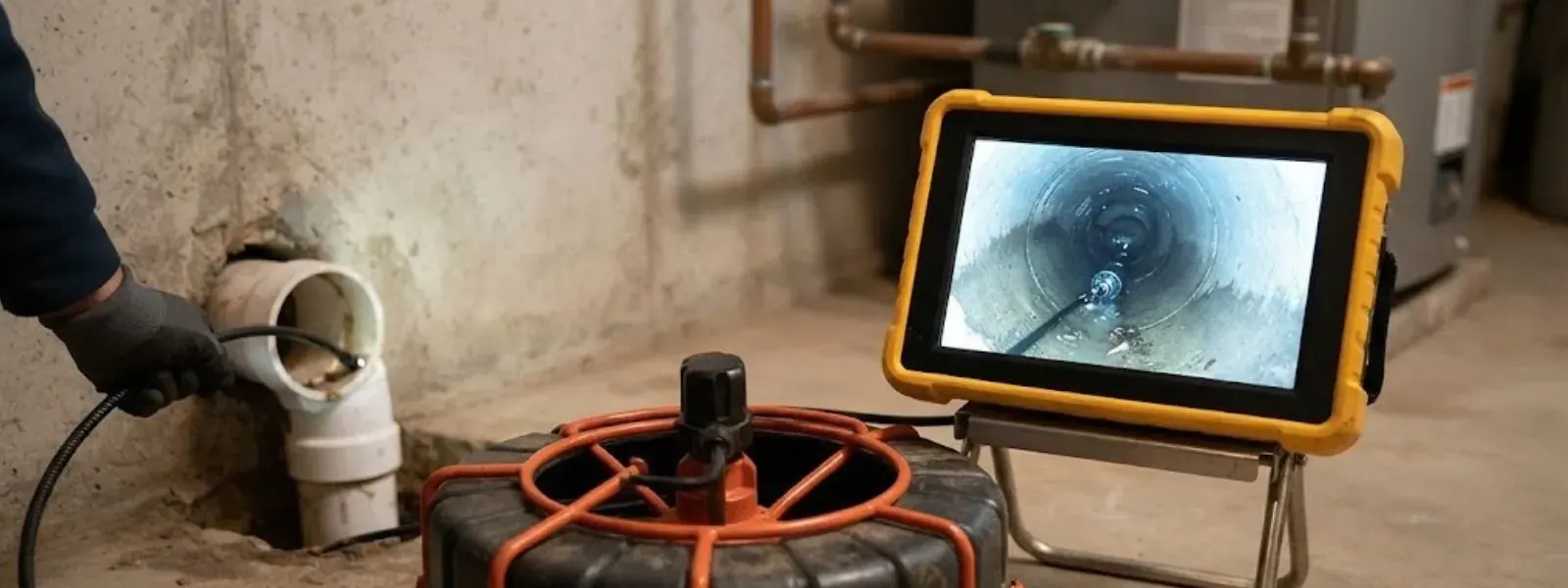
Under a house is a pipe you will probably never see, and it can cost more to fix than almost anything above it. A sewer inspection puts a small waterproof camera on a flexible cable into that pipe, so what you decide about a purchase, a repair or a recurring backup is based on what is really there.
In Elmwood Park, where the median home was built in 1955, the line from the house to the street is often original. A camera visit is how you learn whether that pipe is sound, tired or failing.
Four reasons people book a camera visit
Most inspections start with a question that a cable or a guess cannot answer.
You are buying a house
A walk-through shows floors and fixtures. It says little about the line under the lawn. A camera check before closing can show roots, a sag or a crack, and gives you something concrete to discuss.
It keeps backing up
Two or three clogs in a year points at a cause beyond bad luck. The camera shows whether buildup, roots or a pipe fault is behind it.
Something smells or the ground is wet
A sewer smell, a soft patch in the yard or a sunken strip can all mean a leak or break along the line.
A dig or remodel is planned
Before a new bathroom, a deck or a trench goes in, it helps to know where the line runs and what shape it is in.
What the camera actually shows
The camera head has its own lights and sits on a push cable. As it moves down the line, the screen shows the pipe wall, joints and anything in the way. We check the cleanout, the pipe material and the pipe's overall shape.
Things the camera can pick out:
- Roots entering at a joint or through a crack
- Cracks, offset joints and broken sections
- A sag or belly where water sits
- Scale, grease and debris narrowing the bore
- The pipe material changing from one type to another
Reading the screen: what you are looking at
The picture can be hard to read the first time. This table translates the common images.
| On screen | What it usually means | What may come next |
|---|---|---|
| Fine white threads at a joint | Roots feeding on the pipe's water | Root cutting, then possible lining or repair |
| A line that goes dark and pools | A belly, or a sag, where waste collects | Monitoring, or replacing that section |
| Crusted brown rings | Scale in older iron | Jetting if the pipe is sound, or replacement if thin |
| A visible gap or crack | A broken pipe leaking at that point | Spot repair, lining or replacement |
| A clean, round, dry pipe | No obvious fault today | Routine care and no repair needed |
Want to know what is in your sewer line?
Call us, tell us why you need the camera, and we will explain what a visit involves and the price before we start.
Before we arrive
A few small things make the visit more useful.
Find the cleanout if you can
A capped pipe in the basement, crawlspace or yard is the usual way in. If you cannot find it, tell us and we will look for other access.
Clear the area
Move boxes and stored items away from the cleanout and the path to it.
Write down the history
Note any backups, smells, past repairs and which fixtures were affected, since this guides where we look.
Be there if you can
Seeing the screen with the plumber is the easiest way to understand your pipe.
Locating the line and marking it
A camera on its own tells us what is inside, but a locator tells us where. The camera head sends a signal that a receiver picks up above ground, so we can mark the line's path and an approximate depth on the lawn or floor.
That matters before a dig. Utilities answer JULIE 811 calls and mark their own lines, but they do not mark a private sewer lateral, so the plumber is the one who finds yours.
What you have afterwards
You leave knowing what the camera found, where it sits and what the choices are. If the pipe looks sound, that is useful too, and it may be all you need.
If you want something to pass to a buyer, a seller, a contractor or an insurer, ask us what is included before you book, because what you receive is not the same for every visit. If the line needs work, sewer line cleaning, hydro jetting or sewer line repair are the usual next steps, and we explain which fits.
What the age of Elmwood Park housing suggests
About 29 percent of homes here were built before 1940 and about 77 percent before 1970, so original cast iron, clay and galvanized lines are common. That does not mean a given pipe is bad. It means a look is worth more here than in a newer suburb.
Houses here are also served by combined sewers owned by the Village, which is why we separate your lateral from the street sewer in what we report. See our service area for where we work.
Camera inspection questions, answered
It depends on access, the line length and what you need to come away with. We give you a clear price before work starts, so ask when you call.
Ask us what is included before you book. What you receive can differ by visit, and we would rather tell you the plan than let you assume.
Yes, when the camera head can be tracked by the locator. We mark the path and approximate depth, which helps before any digging.
Yes. Seeing the pipe first keeps a quote honest, and it shows whether a cable, a jet or a repair actually fits.
Usually, yes. Roots show clearly on camera, along with where they enter the pipe, which decides whether cutting or repair makes sense.
We can sometimes go in through a toilet or a floor drain. A house with no cleanout may be worth fitting one so future visits are simpler.
Standards and sources: Work in Illinois follows the Illinois Plumbing Code (77 Ill. Adm. Code 890), and the Village of Elmwood Park building department applies those minimum standards locally. Backup and flood guidance comes from the Metropolitan Water Reclamation District flood resource guide, which advises keeping only waste and toilet paper going down the toilet.