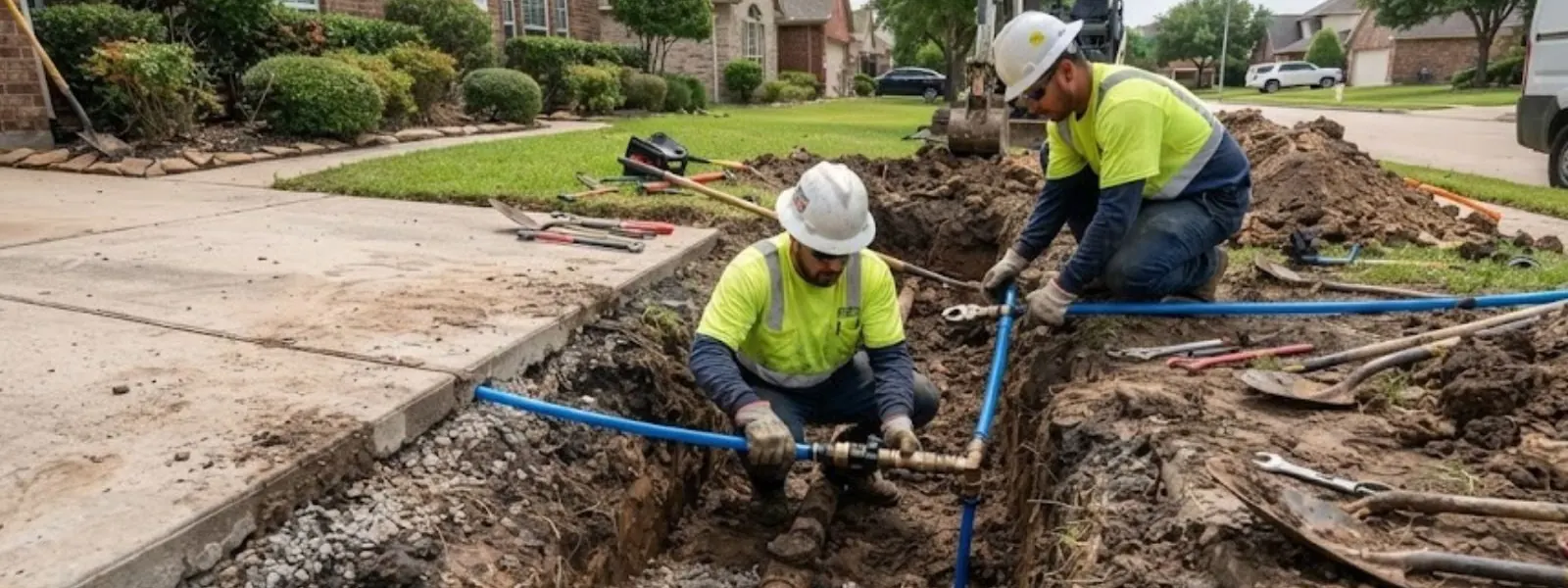
One buried pipe carries every gallon your house uses, and nobody ever sees it. When that service line fails in Elmwood Park, the 24/7 line is open. If water is surfacing in the yard or the whole house has lost pressure, close the house main valve, stay off any soft ground near the leak, and note whether the meter is still turning.
Water line repair means fixing or replacing the service line, the pipe that runs from the water main in the street, past the meter and into the house. The Village buys Lake Michigan water from Chicago, meters it and pumps it to homes, so this line is where public water becomes yours.
Signs the problem is the line under the yard, not the plumbing inside
Pressure falls everywhere at once
Every tap, the shower and the washer all weaken together. A single weak fixture usually points to that fixture instead.
A soggy or sunken spot
A wet patch, a dip in the lawn or a strip of unusually green grass can mark the path of the pipe.
The meter runs with everything off
Movement while the house is quiet points to a leak somewhere past the meter. See leak detection for how to check.
No water at all
If neighbors still have water, the line to your house may have broken or the main valve closed. If neighbors are dry too, that is a Village matter.
Rushing sound near the entry wall
A hiss or rush where the pipe comes through the foundation suggests a leak or a failing joint at that spot.
No water or a gusher right now: who to call first
When water stops or pours, the first call depends on which side of the meter the trouble is on.
| What is happening | Likely side | Call first |
|---|---|---|
| Neighbors have no water either | The Village main or a street-side problem | Village public works |
| Water bubbling up at the curb or in the street | Street side of the meter | Village public works, and report it |
| Only your house is affected and the meter spins with the house valve closed | Your service line | Us, on the 24/7 line |
| Hot water weak or missing but cold is fine | Water heater, not the line | See water heater repair |
Where the Village's responsibility ends and yours begins is a question for the Village, so ask before you assume. We can start work on the private side once you tell us what you have found.
How a service line job unfolds, from the 811 call to the flush
Confirm the line is the culprit
We close valves, read the meter and listen along the pipe, so we are not digging up a yard for a fixture problem.
Call 811 before any digging
Illinois law requires a JULIE locate at least 3 days and no more than 10 before digging, at any depth, at no charge. Marks last 25 days. Utilities do not mark private lines, so we locate those ourselves.
Open the ground carefully
We excavate to the pipe, by hand near other utilities, and keep a path for water to drain from the trench.
Join, test and flush
New pipe goes in with proper fittings, the line is pressure-tested, and the system is flushed before water returns to your taps.
Backfill and restore
We return the soil and compact it. Lawn, concrete and driveway finishing may be separate trades.
No water, or water where there should not be any?
Our plumbers answer the 24/7 line and can look at your line when a same-day slot is open.
Repair a section or replace the whole line
A spot repair makes sense when
- One break sits in an otherwise sound, modern pipe.
- The pipe is accessible and the surrounding line is in good shape.
- No lead is involved.
- The line has not failed before.
Full replacement makes sense when
- The pipe is galvanized steel, corroded or has failed more than once.
- The line is lead, or its material is unknown and old.
- Multiple leaks or weak spots are found while digging.
- Pressure has declined for years and the pipe interior is rough.
Lead changes the picture. Illinois law bars partial lead service line replacement in general, so a repair that touches a lead line may turn into a full replacement.
Lead service lines: the Village inventory and State law
Many older lines across the country were made of lead, and the State now requires communities to track them.
The Village survey
The Village is surveying water service materials under the Illinois Lead Service Line Replacement and Notification Act, and asks owners and tenants to answer its Water Service Material Inventory.
The inventory
Ask the Village for a copy. It also says it has started planning for lead service removal over the next few years.
State law on partial replacement
Illinois generally bars replacing only part of a lead line, so a repair is not always the shortcut it seems.
What we do not do
We do not guess your pipe material from the street. The material is confirmed by looking at the line itself, or from Village records.
How deep a line has to be, and why shallow ones fail in winter
The Illinois plumbing code sets a minimum burial depth for a water service of 36 inches or the local frost depth, whichever is greater. A line laid shallower, or one that settled with age, can freeze in a hard cold snap.
O'Hare reached minus 23 degrees on January 30, 2019. A line near the surface, or one passing under a driveway apron, is where trouble starts. When we replace a line, we bury it to the required depth.
Replacing a line without trenching the whole yard
Trenchless methods pull or push a new pipe through the path of the old one, working from a small pit at each end. That can spare a lawn, a walk or a driveway, but it needs a suitable path, and not every line qualifies. We look at what is under your yard before suggesting it.
Who owns the pipe, and what the Village may require
Ownership of the service line usually divides somewhere along its length, but the exact point depends on the Village, so ask Village public works before assuming. Do not dig near the street or the curb stop on your own.
Plumbers working in the Village file a State licence, proof of liability insurance and a bond, and a permit is paid before the job starts. Whether yours needs one depends on the work, so ask the building department. Inspections need two working days notice.
What drives the price of a service line job
Length, depth, pipe material, what sits above the line (lawn, concrete, a tree), whether it is a repair or full replacement, and permit and inspection steps all shape the total. You get a clear price before work starts.
Water line questions from Elmwood Park property owners
Yes. A broken line does not wait for a weekday, so the 24/7 line takes these calls at any hour. On the phone we cover where the main valve is and whether a same-day slot is open.
The meter is the usual dividing point for testing, since a leak that keeps the meter turning after the house valve is closed lies between them. The legal line of ownership is a question for the Village.
Yes, the locate comes before any dig. Utilities mark their own lines, while private ones are located by the plumber. Because the law asks for notice ahead of time, an urgent leak is stabilized first and the dig is planned around the marks.
We cannot tell from the street, and no one can say it about your home from a general statement. Ask the Village for its inventory, or have the pipe where it enters your house inspected.
Illinois generally bars partial lead service line replacement. If we find lead during a repair, we stop and explain the options before going further.
A spot repair can be a matter of hours. A full replacement takes longer, and trenchless work may differ. We explain the schedule at the visit.
No. It can be the line, a partly closed valve, a failing pressure regulator, clogged aerators or old galvanized pipe inside the house (see repiping). We test before recommending digging.
Standards and sources: Work in Illinois follows the Illinois Plumbing Code (77 Ill. Adm. Code 890), and the Village of Elmwood Park building department applies those minimum standards locally. Digging guidelines come from JULIE (811): call at least 3 days and not more than 10 days before a dig, and note that private lines are not marked by utilities.