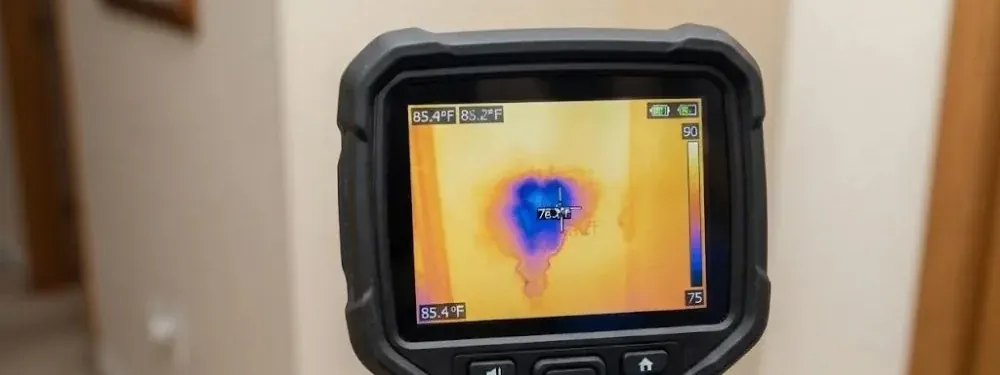
Yes, we find leaks that nobody can see, and the 24/7 line is open when water shows up in your Elmwood Park home where it should not. If it is spraying or pooling right now, close the main valve, keep clear of wet outlets and appliances, and put a bucket or towels where it lands. Then call us and describe what you found.
Leak detection is the work of locating a hidden water loss before anything is opened up, using sound, heat, moisture and pressure so that the repair happens in one place instead of across a whole room or floor. Homes here are often 50 to 90 years old, so original pipe tends to be what runs behind walls and under floors.
High water bill? Run the meter test before paying for anything
The Village meters your water, so a leak shows up as a number that keeps climbing. A bill that creeps upward for months, or jumps in one cycle, is the usual first clue. You can confirm it yourself.
Twenty minutes at the meter
- Stop all use. Close every tap, make sure no one flushes, and pause the washer, dishwasher, ice maker, humidifier and any irrigation.
- Read the meter. Find it, usually where the water line enters the house. Many have a small dial or triangle that spins with any flow. Write down the numbers.
- Wait and recheck. After 15 to 30 minutes, read it again. Movement means water is going somewhere.
- Close the house main valve. If the meter stops, the leak is inside the house. If it keeps moving, the leak is on the pipe between the meter and that valve.
- Rule out the toilets. Drop a little food coloring into each tank. If color reaches the bowl without flushing, a flapper is leaking.
Slab leak signs: what the floor and the house tell you
A slab leak is a pipe leaking under or inside a concrete floor. A house on a slab, a basement floor or an addition poured on a slab can all show the same signs.
A warm spot underfoot
A patch of floor that feels warm points to a hot water line leaking beneath it.
Running water, nothing on
A faint rush or hiss at night with every tap off is worth taking seriously.
A meter that keeps turning
Movement with the house shut down is the strongest clue, and the meter test above confirms it.
Hot water that arrives late
A hot line losing water into the ground can slow the supply and keep the heater working harder.
Damp flooring or lifted edges
Wet carpet, cracked tile or a swollen baseboard suggests water from below.
Hidden leaks in walls and ceilings: where the water travels before it shows
The stain on a ceiling is rarely directly below the leak. Water runs along a joist, a pipe or the back of the drywall before it finds a place to drip, so a kitchen ceiling can be wet from a bathroom a few feet away. Our plumbers trace the path backward instead of cutting at the stain.
We check likely sources first: a shower pan or tub overflow, supply connections under a fixture, a drain trap, and a vent pipe. A moisture meter maps damp areas without damage, and a thermal camera shows cool or warm patches that follow a pipe run.
When the source sits behind finished drywall, a small inspection opening is sometimes the only way to confirm it. We keep it small and the patching is straightforward. Painting and finishing belong to another trade.
What each leak-finding method picks up, and where it struggles
Different leaks call for different tools, and most searches use more than one. Here is what each does and does not tell us.
| Method | What it picks up | Where it struggles |
|---|---|---|
| Acoustic listening | The sound of water escaping from a pressurized pipe, through floors, walls or soil | Noisy street traffic, plastic pipe that muffles sound, very small leaks |
| Thermal camera | Temperature differences from hot lines or wet material | Cold water lines in cool surroundings, thick finished surfaces |
| Moisture meter | Dampness in wood, drywall and plaster | It shows wet material, not the source |
| Pressure test | Whether an isolated pipe section holds pressure on a gauge | It confirms a leak exists, not exactly where |
| Tracer gas | A safe gas blend pushed into an emptied line and sniffed at the surface, where the situation calls for it | Needs a line that can be drained and sealed, and access to sniff above it |
Water showing up and no idea why?
Call the 24/7 line. We will tell you what to shut off and book a visit as soon as a slot is open.
Outside and underground: leaks between the street and the house
A leak in the buried line shows itself differently. Look for a soggy or sunken patch of lawn, a strip of grass greener than the rest, a damp spot by the foundation, or water at the surface when it has not rained. Pressure that drops through the whole house is another hint.
Utilities do not mark private lines, so we find the path ourselves before listening along it. Once located, repair is a separate step, covered under water line repair.
The water heater: the leak that looks like something else
A puddle near the tank is not always the tank. A dripping drain valve, a loose supply or hot outlet fitting, a T&P valve discharging, or condensation on a cold pipe can all pool beneath it. We check these first before calling the tank itself finished.
A tank that has rusted through is a different story, and replacement is the honest answer. See water heater repair for the checks we run on those.
Where finding the leak stops and opening up starts
Detection narrows the search, often to a small area, but it never guarantees an exact spot. Sometimes a small hole in drywall, tile or a slab is the only way to confirm. We keep access holes small. Tile, concrete and paint finishing is its own trade.
An active leak right now, or one that can wait for a visit
Call us right now
- Water is spraying, pouring through a ceiling or pooling near electrical items.
- The meter races with every fixture off.
- You hear running water in a wall and cannot reach the main.
- A hot water line is leaking and the floor feels hot.
Book a daytime visit
- A stain that has not grown in weeks and is dry to the touch.
- A bill that climbed but a clean meter test.
- A damp patch in the yard that appears only after heavy rain.
- A home inspection or sale where you want a pressure check.
What drives the cost of a leak search, and shops and apartment buildings
Price follows how many tests it takes, how large and how hard to reach the area is, whether the leak is inside, under concrete or buried, and what access the repair then needs. You get a clear price before work starts.
The same methods work in a store, an office or a multi-unit building, where the extra challenge is shared lines and tenants in several units. Tell us it is commercial when you call, and see commercial plumbing.
Leak detection questions from Elmwood Park homeowners
Yes. Leaks do not keep office hours, so the line takes these calls after dark and on weekends. Timing depends on the schedule that night, and on the phone we talk you through the shut-off.
Usually to a small area, often confirmed by two methods before anything is cut. Plumbing is not exact science, so we describe the spot as a best reading, not a promise.
Acoustic listening gear, a thermal camera, a moisture meter, pressure gauges, and tracer gas where the situation calls for it. We choose the mix after talking with you.
Yes, our licensed plumbers repair the pipe, whether that means a patch, a section replaced or a new route. If the repair means opening a slab or wall, we explain it first.
Run the meter test above. If the meter moves with the house shut down, a hidden leak is likely. If it does not, check toilets, irrigation and recent habits.
Usually yes, in moderation, unless water is near electrical items or the leak is spraying. Closing the house main stops the loss while you wait for us.
Yes. Older pipe often leaks at joints and in thin spots. If the same line keeps failing, we will talk through repiping as an alternative to repeated patching.
Standards and sources: Work in Illinois follows the Illinois Plumbing Code (77 Ill. Adm. Code 890), and the Village of Elmwood Park building department applies those minimum standards locally. Licence guidance comes from the Illinois Department of Public Health, whose online lookup verifies any Illinois plumber.