Picture a Saturday morning in a two-bath house. One person is showering, the dishwasher is running and someone starts the washing machine. A tank heater handles that by pulling from a stored reserve. A tankless heater has no reserve, so it has to heat everything on the spot.
That single difference drives every decision in this guide, from sizing to fuel choice to what an older Elmwood Park house needs behind the wall. Read it as a buyer's checklist, and keep a plumber in the loop before you commit to a model.
Tank or tankless: what actually changes in the house
Neither type is better in every home. They solve the same problem with different trade-offs.
Traditional tank
- Keeps a reserve of heated water ready
- Simpler installation, usually fewer upgrades
- Standby heat loss while the tank sits full
- Runs out when demand outlasts the reserve
- Takes up more floor space
Tankless
- Heats water only when a tap opens
- Wall-mounted and compact
- Water supply never runs out of stored volume
- Heavy demands on gas supply, venting or electric service
- Needs periodic descaling to keep its flow
For a household that wants endless hot showers and has the utilities to support it, tankless can make sense. For a house where the gas line, vent path or electrical panel would need major work, a high-quality tank may serve better. Our tankless water heater team can look at both options on site.
Sizing begins with what runs at the same time
Forget square footage. Tankless sizing comes down to two questions. How many hot water fixtures could be running together on your busiest morning, and how much does the water need to be warmed on its way through?
The second question is called temperature rise, the gap between incoming cold water and the temperature you want at the tap. A bigger gap means the heater has to work harder, which lowers the flow it can deliver. Manufacturers publish flow ratings at different rises, and a plumber reads those charts against your real fixtures rather than trusting a headline number.
Write down your simultaneous uses before you shop. A shower, a kitchen faucet and a washing machine tend to be the combination that stresses a unit. Low-flow showerheads reduce the load. Rain showers and body sprays raise it sharply.
Gas or electric: a plain comparison for older houses
| Question | Gas tankless | Electric tankless |
|---|---|---|
| Main demand on the house | Gas line capacity and a vent path | A large electrical service and dedicated circuits |
| Work usually involved | Venting, condensate drain, possibly a bigger gas pipe | Panel upgrade or new heavy wiring by a licensed electrician |
| Fit for a whole house | Common choice for larger demand | Often better for a single bathroom or small home |
| Biggest risk to check | Combustion air and exhaust routing | Panel capacity already used up |
| Who does what | Licensed plumber, with permit questions to the Village | Licensed electrician for the wiring |
Whichever fuel you choose, a heater that is wired or piped wrongly is a safety hazard, not just an inconvenience.
Want your gas line and vent path checked first?
A licensed plumber can walk your basement, meter and vent route before you buy a unit, and explain the price before any work begins.
Gas line capacity and venting in a house built decades ago
A tankless gas heater can demand far more gas at peak than the tank it replaces. An older house may have a modest gas pipe feeding the furnace, range and dryer, with little to spare. The plumber measures the run from the meter, counts every appliance and decides whether the existing pipe can carry the added load or needs upsizing.
Venting is the second hurdle. High-efficiency units use plastic vent pipe that runs through an exterior wall or the roof, and the termination point must stay clear of windows, vents and walkways. Older flues made for standard tanks are usually not suitable. Combustion air matters too, because a heater starved of air burns poorly and can produce carbon monoxide.
Install a carbon monoxide alarm near any gas appliance and test it regularly. Never block a vent or seal a utility room tight around a burner.
Gas smell? Do not stay and investigate
If you smell gas at any point, leave the building at once. Do not touch switches or use your phone inside. Call the gas utility and 911 from outside.
Winter water is the number that surprises people
In the Chicago area, incoming cold water gets noticeably colder in winter. A tankless unit that kept up fine in October may deliver less flow in January because it has to lift the water through a larger temperature rise. Pick a unit sized for the coldest months rather than the mild ones.
If a manufacturer's chart shows flow dropping at higher temperature rises, take that seriously. Sizing for the worst day is cheaper than apologizing to your family every winter.
Questions to settle before ordering a unit
Pre-purchase checklist
- Your peak demand. List every hot water fixture likely to run at once and match it to the unit's flow rating at winter temperature rise.
- Fuel and supply. Confirm gas pipe size and meter capacity, or panel space for electric. Ask for it in writing from the installer.
- Vent route. Walk the path from the unit to the outside with the plumber. Note any windows, corners or long runs.
- Condensate and drain. High-efficiency units produce acidic condensate that needs a proper drain or neutralizer.
- Permit and inspection. Ask the Village what your job requires. Do not assume.
- Service plan. Decide who will descale the unit and when. Hard use shortens the interval.
Descaling keeps a tankless unit honest
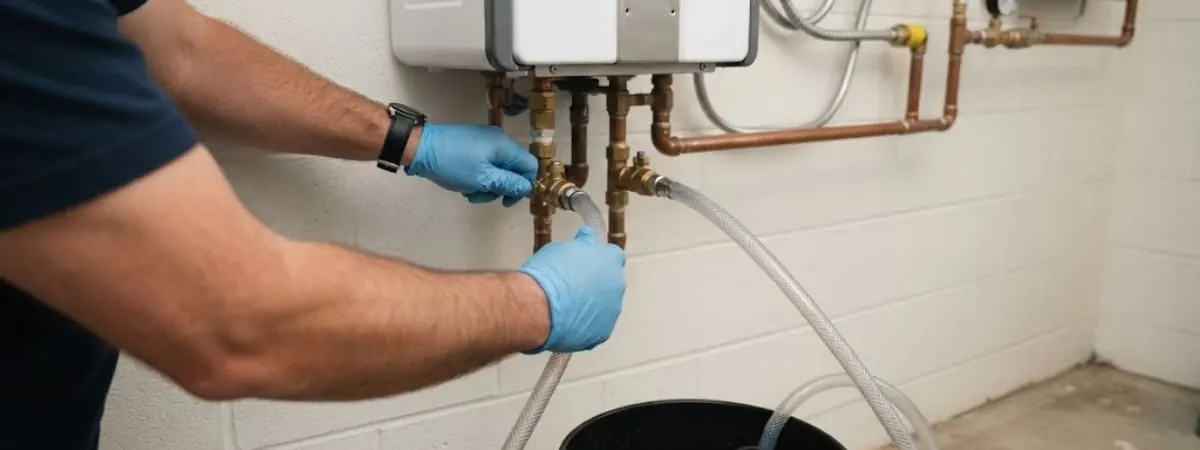
Mineral scale collects inside the heat exchanger and narrows the passages. The symptoms are slower flow, higher temperatures swinging up and down, error codes and noise. Descaling means flushing the unit with a mild acid solution through isolation valves, which is why installers fit service valves at the start.
Many manufacturers suggest annual or periodic service, with intervals depending on your water. Skipping it voids some warranties and wears the unit prematurely. If your unit has no service valves, a plumber can add them.
Already have a tankless unit that is acting up?
Cold sandwiches, error codes and weak flow are things our plumbers diagnose every day.
Tankless planning in Elmwood Park: gas, permits and cold snaps
Nicor Gas serves Elmwood Park, though you should check your own bill since some addresses may be served by another utility. That matters because a tankless installer will want to confirm meter capacity with whoever supplies your gas. The median home here was built in 1955, so many houses have the sort of mid-century gas piping that should be measured before it is asked to feed a high-demand heater.
The Village follows the Illinois State Plumbing Code, and its plumbing permit form lists water heaters. What your installation needs is a question for the Village building department, since requirements differ from job to job. Contractors register with the Village by filing a State licence, proof of liability insurance and a bond, and fees are paid before work begins. Inspections are booked with two working days of notice.
Cold weather is no abstraction in this area. O'Hare reached minus 23 F on January 30, 2019, and that kind of cold shows up in your incoming water. If your project also involves digging for a new gas or water line outside, Illinois law requires calling 811 at least 3 days before you dig. Utilities do not mark private lines, so your plumber locates those.
When you are ready to plan, see our water heater installation page, and see where we work on our service area page. Neighbors to the west can read our River Grove plumber page.
Sources: Nicor Gas service information, CMAP housing snapshot, Village of Elmwood Park permit and plumbing code pages, NWS Chicago climate records, JULIE 811 rules
Tankless water heater questions from homeowners
Many manufacturers describe a longer service life than tank heaters when maintained. Actual life depends on your water, how often it is descaled and how hard the unit works. We will not promise a number, but regular service clearly helps.
Most gas units still need electricity for the controls, fan and ignition, so they will not run in a blackout. Ask about battery backup or a generator plan if outages concern you.
That is the cold water sandwich. Hot water in the pipes cools, the unit ignites again and the delay lets a slug of cold water through. Recirculation lines, small buffer tanks and correct sizing reduce it.
Not safely in most cases. Gas connection, venting and permit questions call for a licensed plumber, and electric models often need a licensed electrician for wiring.
That depends on the job, so ask the Village building department. Its plumbing permit form lists water heaters, and our plumbers can explain the process before work starts.
We do not have a published water temperature for the Village, so we will not give one. We do know the area sees severe cold, with O'Hare reaching minus 23 F in January 2019, so size a unit for winter rather than autumn.
Standards and sources: Work in Illinois follows the Illinois Plumbing Code (77 Ill. Adm. Code 890), and the Village of Elmwood Park building department applies those minimum standards locally. Gas smell guidance comes from Nicor Gas: leave the building, then call the gas utility and 911 from outside.