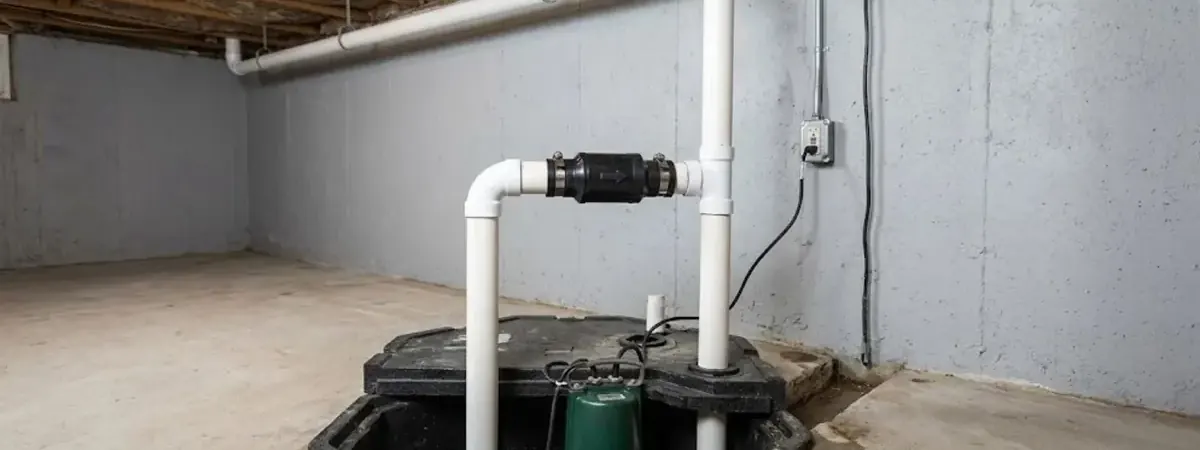
Storms that knock out power are the same storms that fill sump pits fastest, which is why a primary pump alone leaves a gap. A backup that does not depend on your electric service closes that gap. One option does it with nothing more than the water pressure already in your pipes.
That is the idea behind a water-powered backup sump pump. This guide explains how one works, where it shines, where it falls short, how it compares with a battery backup, and what to check with the Village before anything is connected to your plumbing in Elmwood Park.
How a water-powered backup actually works
A water-powered unit hangs in the sump pit above the water line, beside the main pump. It connects to your home's cold water supply. When the pit rises past the backup's float, a valve opens and municipal water is forced through a narrow nozzle and a venturi, a tapered passage that speeds the flow and creates suction.
That suction pulls pit water up and out through the same outlet pipe, mixing it with the supply water as it goes. The more supply water you push through, the more pit water you move. Nothing in it needs electricity, a charged battery or a motor, and that is the whole appeal.
The case for it, and the case against
What it does well
- Works through power outages with no battery to charge or replace.
- Few moving parts, so there is not much to wear out.
- Can run for as long as water pressure holds, with no battery limit.
- Sits quietly in the pit until it is needed.
What to weigh carefully
- Uses a lot of supply water while it runs, and you pay for what the meter records.
- Needs adequate water pressure, so low pressure means poor performance.
- Moves less pit water than a good primary pump or a strong battery pump.
- Needs a proper connection to the supply, with backflow protection, where local rules require it.
The supply water and the pit water leave together through the pit's outlet. Pressure from a private well is a poor match, while a municipal supply is the usual setting, though local rules still come first.
Want a pump plan before the next storm?
Our plumbers can look at your pit, your discharge and your options. Call the 24/7 line, and we will give a clear price before work starts.
Primary pump, battery backup and water-powered backup side by side
Each option answers a different weakness. Most flood-prone basements do best with a strong primary and one backup, chosen to suit the house.
| Type | Power source | Main strength | Main limit |
|---|---|---|---|
| Primary pump | Household electricity | Handles everyday groundwater | Stops in a power outage |
| Battery backup | Charged battery | Moves a lot of water for a while | Battery ages and runs down |
| Water-powered backup | Municipal water pressure | No electricity or battery | Uses supply water, needs pressure |
| Combination setup | Mixed | Layers of protection | More parts to test and maintain |
Check connection and discharge rules before you buy
A water-powered backup ties your drinking water line to a pit that holds groundwater, so backflow protection is not optional. Plumbing codes generally address this, but rules about connections and where the discharge may go vary, and we cannot assume anything is allowed for your address.
Before installing one, ask the Village whether the connection, the backflow device and the discharge route are acceptable. Ask rather than assume. Our sump pump repair and installation team can install the plumbing once you know the answer.
Also confirm where the outlet leads. Discharging to a lawn, a sanitary line or a storm line each carries its own rules, and sending clear water into the wrong line can create problems for you or neighbors.
Testing any backup, so it works when you need it
Test the primary pump first
Pour a few buckets of water into the pit and watch the pump start, run and shut off cleanly. Listen for grinding or a motor that hums without moving water, and check that the float swings freely instead of catching on the pit wall or the cord.
Test the backup on its own
For a water-powered unit, lift the float or let the pit fill until it starts. Watch it pull water down.
Check the outlet
Make sure the discharge pipe is clear, the check valve is working and water leaves the house without returning.
Set a reminder
Test every few months and before storm season. A backup you have never tested is a hope, not a plan. Write the date on the pit lid or in your phone so the next test does not slip.
Water already in the pit?
Do not wait to see how high it climbs. Call our emergency line, and our licensed plumbers will check the pump and the outlet.
Signs your basement protection is not enough
A pump can look fine and still be undersized or worn out, and a pump that has run for many years is worth having a plumber inspect before the wet season.
Pump runs constantly in wet weather
It may be undersized or the check valve may be failing.
Pit water level rises despite the pump running
Flow in may exceed flow out.
Rust, odd noises or a burning smell
Replace the motor before it quits mid-storm.
Water at the floor drain, not the pit
That may be sewer backup, which a sump pump does not stop.
Elmwood Park flooding, combined sewers and your pit
Sewers here are combined, meaning rain runoff and household waste travel in one pipe, and a heavy storm can push water back up into basements. A sump pump handles groundwater around your foundation, but it does not stop sewer backup, which is a different problem needing a backwater valve or overhead sewer.
The area has a flood history. FEMA flooding declarations came in 2007, 2008 and 2011. In July 2011, several feet of water stood on Oak Leaf Avenue and cars stalled on 80th Avenue. A flood mitigation project to reduce sewer backups was completed in 2015, but heavy storms can still overwhelm local systems.
The Village has run a flood-proofing assistance program that shares costs on protective upgrades, and its form says inspectors will review an existing system. Ask the building department whether the program is open now and what it covers today. Also ask your insurer about sewer backup coverage.
Our plumbers also serve River Grove, where the Des Plaines River drives flood risk instead. See our River Grove page, the service area and our basement waterproofing page.
Sources: Cook County hazard mitigation annex, MWRD flood resource guide, Village of Elmwood Park flood-proofing form
Backup sump pump questions from Elmwood Park basements
No. It runs on the pressure of your municipal water supply, which is why it is popular for outages. Your water pressure must be adequate.
It can, because it uses supply water to move pit water. The meter records what it uses, so it is best for occasional outage use.
Neither is better in every case. Battery backups move more water for a limited time, while water-powered units run as long as pressure holds.
Rules about connections and backflow protection vary, so ask the Village building department before buying one. Do not assume it is allowed.
No. The sewers here are combined, so backups can arrive through the sewer line itself, which calls for a backwater valve or similar protection.
The Village has offered cost-sharing for flood protection upgrades. Ask the building department whether the program is open now and whether a backup pump qualifies.
Every few months, and before the wet season. Pour in water and confirm the pump starts, runs and shuts off.
Standards and sources: Work in Illinois follows the Illinois Plumbing Code (77 Ill. Adm. Code 890), and the Village of Elmwood Park building department applies those minimum standards locally. Flood guidance comes from the Metropolitan Water Reclamation District and the Village of Elmwood Park flood-proofing pages.