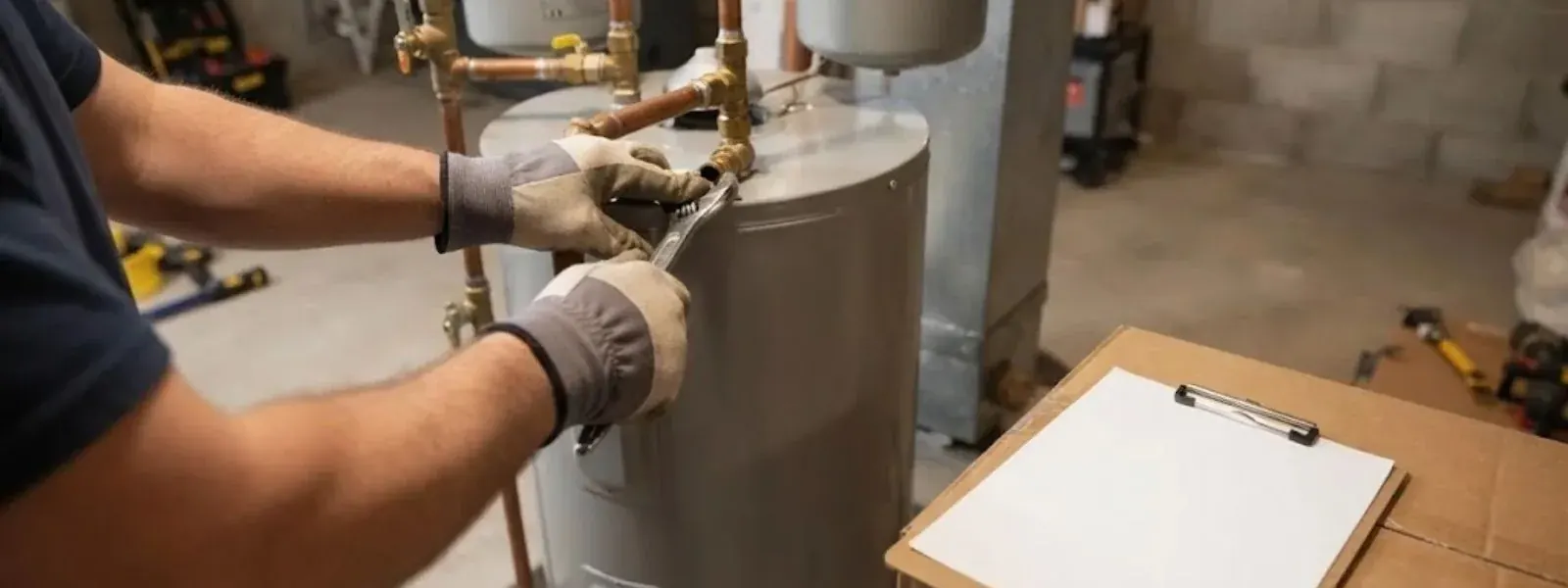
Picture a water heater in a finished basement, framed in by a laundry room and a rec room carpet. A pinhole at the base of the tank starts to weep. Without a pan, that water finds its own path across the floor. With one, it has somewhere to go.
This guide explains what a water heater drain pan in Elmwood Park, IL can and cannot do, how it is sized, where it should drain, how it relates to the T&P valve pipe and how leak sensors add a second layer. Codes and local rules vary, so ask the Village building department what applies to your job.
A pan catches slow leaks, not tank failures
What a drain pan does
- Collects water from a slow leak at the tank base, a fitting or a failing relief valve.
- Carries it through a piped drain to a safe visible location.
- Gives you time to notice and call before flooring and drywall are damaged.
- Protects finished floors and framing near the heater.
What a drain pan does not do, and what to do instead
- It does not stop a tank from failing or a pipe from bursting.
- It cannot contain a full tank, which can hold dozens of gallons, if the tank splits.
- It does not replace maintenance, anode checks or flushing.
- It will not keep working if the drain is clogged, undersized or pitched the wrong way.
That is the honest picture. A pan is cheap protection against a slow leak and a good partner for a leak sensor. It works only if the water it catches has a clear way out.
Sizing the pan to the tank
Sizing is not complicated, but the details matter. These are the measurements a plumber checks before choosing a pan.
| Check | What to look for | Why it matters |
|---|---|---|
| Pan diameter | A couple of inches wider than the tank on every side | Leaks can run down the jacket and spread |
| Rim height | Enough to hold a meaningful amount before overflowing | Shallow pans spill sooner |
| Drain fitting | Sized for the pan drain pipe and kept clear | A small or blocked fitting backs up |
| Material | Plastic, steel or aluminum rated for the heater | Gas units need a pan that tolerates heat from below |
| Floor condition | Level, clean and strong enough for the full tank weight | A tilted pan drains to one side or not at all |
Adding a pan to an existing heater?
Our licensed plumbers can lift the tank, set a correctly sized pan and pipe the drain to a safe place.
What installing a pan under an existing heater involves
Shut down and drain
Power or gas is switched off, the cold supply is closed and the tank is drained, since a full tank is too heavy to move safely.
Disconnect and lift
Water, gas and vent connections are loosened. The heater is raised and moved. Gas and flue work should be handled by a licensed plumber.
Place the pan level
The pan is set on a clean, level surface. Shims are used where the floor is uneven, since a tilted pan will not drain.
Pipe the drain
A drain pipe is attached to the pan fitting and run with downward slope to its endpoint. Joints are tested with water.
Reconnect and test
The heater is set back, reconnected, refilled, checked for leaks and relit or powered. Venting and the T&P valve pipe are rechecked.
Where the pan drain should end
The best endpoint is a safe, visible place that water can reach by gravity, such as a floor drain located near the heater or an exterior wall with a proper termination. The drain should slope downward all the way and be at least as large as the pan fitting.
Avoid hidden endings. A drain that vanishes behind a wall or runs into a pipe nobody inspects can leak for months. Do not plug, cap or reduce the line, and do not tie it to a sump pit unless your plumber confirms it is allowed.
The T&P valve pipe is a separate job
The temperature and pressure relief valve is a safety device that opens if the tank gets too hot or too pressurized. A discharge pipe attached to it must run downward to a safe place where scalding water will not hit a person. It must not be capped, plugged, threaded at the end or fitted with a valve.
Many plumbers keep this pipe separate from the pan drain, and a few jurisdictions combine them with specific rules. Codes and local rules vary, so ask the Village building department. Never close off a T&P discharge to stop a drip. A dripping valve usually means it needs inspection or the tank needs an expansion tank.
What a pan tells you if you look inside
Check the pan every few months. A quick look can catch a problem early.
Water standing in the pan
A leak. Look for the source, from the tank base to fittings and the relief valve.
Rust flakes or orange stains
The tank may be corroding at the base, which is often the start of a failure.
White mineral crust
Slow seepage at a fitting has evaporated and left deposits behind.
A clogged or dusty drain port
Debris can block the outlet, so water would sit and overflow instead of leaving.
A pan that sits crooked
It will not drain correctly. The tank should be lifted and the pan leveled.
Heater older than the pan?
If the tank is near the end of its life, it may be smarter to replace it and set the pan during the same visit.
Leak sensors and automatic shutoffs as a second layer
A small battery sensor placed in the pan sounds an alarm when it gets wet. Some connect to a phone. They cost little and catch what a pan alone cannot, which is the first drop. Check the battery on a schedule.
An automatic shutoff valve on the cold supply goes further. When a sensor reports water, it closes the supply to the tank so a leak cannot keep feeding the pan. Hardwired units may need a licensed electrician, and your plumber can advise on placement, especially with a new water heater installation where the layout is still open.
Water heater pans in Elmwood Park basements: drains, rain and permits
Many Elmwood Park homes have their water heater in a basement, often next to a laundry area or a finished room. Homes here are typically 50 to 90 years old, with a median build year of 1955, so heaters are often placed near an old floor drain or a utility corner. That is where a pan drain can end, if the drain is clear and sloped to receive it.
Elmwood Park is served by combined sewers, and heavy rain can push water back up into basements. A pan drain that ends at a floor drain can therefore carry sewer water backward during a storm. Ask your plumber whether the floor drain has a backwater protection device, and how the pan drain should be arranged so it does not become an entry point.
The Village plumbing permit application lists water heater work among its items, and the Village follows the Illinois State Plumbing Code. We do not claim what a given job requires. Codes and local rules vary, so ask the Elmwood Park building department.
We install and replace heaters across the Village and in neighboring River Grove. If your tank is near the end of its life, our water heater replacement page explains what to expect, and the service area page shows where we work.
Sources: Village of Elmwood Park plumbing permit form and licensing page, MWRD flood resource guide directory, CMAP community data
Drain pan questions from Elmwood Park homeowners
Codes and local rules vary, so ask the Village building department what applies to your job. In practice, many plumbers recommend a pan wherever a leak could damage a finished floor or a room below, and a pan is a sensible choice in basements with living space.
A pan without a drain holds only a small amount of water and can hide a leak until it overflows. A piped drain to a safe visible location is what makes the pan useful. If there is no way to drain by gravity, ask the plumber about other options.
It should be a couple of inches wider than the tank on every side, with a rim high enough to hold some water and a drain fitting matched to the pipe. Your plumber measures the tank and checks the floor before recommending a pan.
It should run downward to a safe, visible spot where hot water will not injure anyone, and it should never be capped or plugged. Many plumbers keep it separate from the pan drain, though local rules vary, so ask the Village building department.
Often, if it is close, clear and not prone to backing up. In a village with combined sewers where heavy rain can push water into basements, a floor drain can also carry water in. Ask your plumber about backwater protection before relying on it.
No. A sensor warns you, and a pan contains the water. Together they give you an alert and some time. Some homeowners add an automatic shutoff valve on the cold supply so a sensor alarm also stops the water.
Yes, in most cases the tank is drained, lifted, set back on a pan and reconnected. Gas, venting and the T&P valve pipe are rechecked, and if the tank is old, a plumber may suggest replacing it during the same visit.
Standards and sources: Work in Illinois follows the Illinois Plumbing Code (77 Ill. Adm. Code 890), and the Village of Elmwood Park building department applies those minimum standards locally. Gas smell guidance comes from Nicor Gas: leave the building, then call the gas utility and 911 from outside.