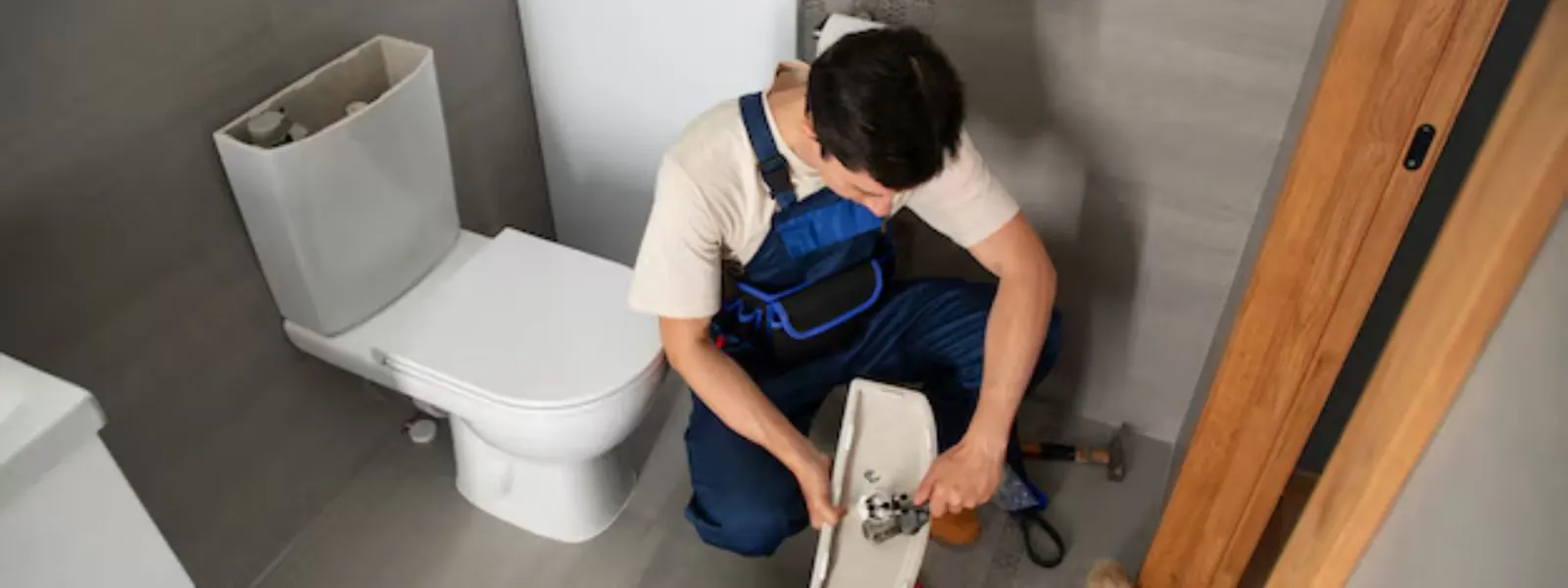
You press the flush lever and nothing happens until you jiggle it, hold it down, or nudge it back up with a finger afterward. Plenty of Elmwood Park households live with that for months. It is one of the friendlier bathroom repairs, because the handle is a small, standard part that comes off with a wrench or pliers and a little patience.
This guide covers how to tell a worn handle from a failing flapper, how to take the old lever off without breaking the tank, and how to set the chain so the toilet flushes and stops cleanly. It also covers the point where it makes sense to hand the job to our licensed plumbers here in Elmwood Park.
Three quick tests before you buy a new lever
Take the tank lid off and set it somewhere safe, ideally on a towel on the floor, because porcelain lids chip easily. Then flush and watch what moves. The goal is to learn whether the handle, the chain or the rubber seal at the bottom is the weak link.
A handle that feels loose, wobbles in its hole or hangs lower than it used to usually points to the mounting nut. A handle that moves normally but the flapper barely lifts points to the arm or chain. A toilet that keeps running after a good flush points elsewhere.
- Handle spins freely or will not spring back: the lever or its nut is the likely cause.
- Handle works but the flush is weak or short: the chain is probably too slack or the arm is bent.
- Handle works, flush is fine, but water keeps trickling afterward: look at the flapper and fill valve instead.
Front, side and angled mounts: matching the new handle
Handles are not all one shape, and the mismatch is the most common reason a replacement does not fit. Look at where the lever sits on your tank before you shop, and bring the old one with you if you can.
| Style | Where it sits | What to check before buying |
|---|---|---|
| Front mount | Centered or near the left on the front face of the tank | Arm length and whether the arm points left or right inside the tank |
| Side mount | On the left or right side wall of the tank | Tank side, since most are made for one side only |
| Angled or corner | Near a corner of a tank that sits tight to a wall | Whether the arm has clearance to swing |
| Dual flush button | Top of the lid, not a lever | A different repair, tied to the flush valve and not a simple lever swap |
Replacing the lever, one step at a time
Shut off the water and empty the tank
Close the small valve on the wall or floor behind the toilet, flush once, and hold the handle down so most of the water drains. A sponge handles what is left. Working in a nearly dry tank keeps the job tidy.
Unhook the chain
Lift the chain clip off the lever arm and let the flapper rest. Photograph the setup first so you remember which hole the chain used and which way the arm pointed.
Loosen the mounting nut
The big plastic or brass nut inside the tank holds the handle in place. Support the outside handle with your other hand, and turn the nut with an adjustable wrench or pliers. Read the next section about its thread direction before you force it.
Fit the new lever
Slide the new handle through the hole, thread the nut on by hand, then snug it. Hand-tight plus a gentle quarter turn is plenty, since a porcelain tank can crack under a heavy wrench.
Reconnect, restore and test
Clip the chain on, open the shutoff, let the tank refill and flush several times. Watch the flapper lift fully and drop back flat. Adjust the chain if it does not.
Stuck on a stubborn nut or a cracked tank?
Our licensed plumbers can finish a toilet repair in one visit. Call us and we will tell you the price before any work starts.
The nut turns the opposite way
On most tank handles, the nut inside the tank has a left-hand thread. That means you loosen it by turning it clockwise and tighten it by turning it counterclockwise, the reverse of most fittings you handle. People who fight it the usual way end up cross-threading or snapping the plastic.
If yours does not give with a gentle clockwise turn, stop and check the old handle for markings. A few models use standard threads. Never use a big wrench or hammer on a stuck nut, because the tank wall is thin.
A little slack in the chain, and no more
The chain connects the lever arm to the flapper, and its length decides whether the toilet works. Too tight, and the flapper hangs slightly open, so water leaks into the bowl all day. Too loose, and the handle lifts the slack without opening the flapper, giving a weak or half flush.
A good rule of thumb is a little slack with the flapper closed, usually around a half inch, or about one or two links. Hook the clip at the link that gives that gap, trim nothing yet, and flush. If the lever has to travel far before the flapper moves, take up a link.
Watch for a long loose tail of chain. It can curl under the flapper and keep it from sealing, which causes a slow running toilet that looks like a handle problem. Pinch off extra links with the clip so only a short tail remains.
When the handle is fine and something else is failing
Swapping a lever fixes a lever. If you still have symptoms afterward, one of these is more likely to be responsible.
Worn flapper
The rubber is soft, warped or slimy, so it no longer seals. Water sneaks past and the tank refills over and over.
Fill valve that will not shut off
Water hisses or runs into the overflow tube after the tank is full. The valve may need adjusting or replacing.
Cracked or loose handle hole
A hairline crack around the mounting hole means the tank itself may need attention. Do not keep tightening.
Bent lever arm
If the arm is bent or the wrong length, the chain angle is off and flushes will be inconsistent.
A quiet running toilet is a loud water bill
A toilet that refills on its own can waste a surprising amount of water without any noise. A few drops of food coloring in the tank, left for about 15 minutes without flushing, will show it: color in the bowl means a leaking flapper.
If you have fixed the toilet and still see unexplained use on your meter or bill, the water may be going somewhere you cannot see. Our team does leak detection with moisture meters and pressure checks, which is easier than guessing behind walls and under slabs.
Toilet still running after the swap?
A second set of eyes saves hours of guessing. Our plumbers handle flappers, fill valves and handles daily. Call the 24/7 line to talk it through.
Toilet repair in Elmwood Park homes, rentals and two-flats
Homes here have a median build year of 1955, with roughly three in four predating 1970. Many toilets here have been repaired, patched or replaced across decades, so you may find a mix of old brass hardware and newer plastic parts in the same tank.
About a third of households here rent, and roughly half of homes are single-family detached while the rest are two-flats and larger buildings. If you rent, report a sticking handle or running toilet to your landlord rather than opening the tank yourself, since a running toilet in a shared building affects everyone's water.
The Village buys Lake Michigan water from the City of Chicago and meters it before it reaches homes, so a toilet that runs constantly can show up in your usage. If you are not sure whether the problem is a handle, a flapper or a leak elsewhere, our team covers neighbors in River Grove as well. See the River Grove plumber page or our service area.
Sources: CMAP community data snapshot (Census ACS) and Village of Elmwood Park water quality report
Questions about toilet handles from Elmwood Park households
For most people, 15 to 30 minutes, including draining the tank and testing. The hardest part is usually a stiff mounting nut. Allow longer if parts are corroded or the tank hole is cracked.
Most tank handle nuts use a left-hand thread, so you turn them clockwise to loosen. Turn gently, hold the handle steady from the outside, and stop if something feels like it is about to crack.
A little, often around a half inch or one to two links when the flapper is closed. Too tight keeps the flapper from sealing, and too loose gives you a weak flush.
Usually not. Constant running is most often a worn flapper, a chain that is too short or a fill valve that does not shut off. A new handle only helps if the lever or chain was the cause.
Because the Village meters the water it buys from Chicago and delivers to your home, a toilet that leaks all day adds to your recorded use. Compare recent bills, and if usage looks high, fix the toilet and consider a leak check.
Call if the tank is cracked, parts are frozen in place, water is leaking around the base, or the toilet still runs after you replace the handle and flapper. Our toilet repair team can usually sort it in one visit.
Standards and sources: Work in Illinois follows the Illinois Plumbing Code (77 Ill. Adm. Code 890), and the Village of Elmwood Park building department applies those minimum standards locally. Backup and flood guidance comes from the Metropolitan Water Reclamation District flood resource guide, which advises keeping only waste and toilet paper going down the toilet.