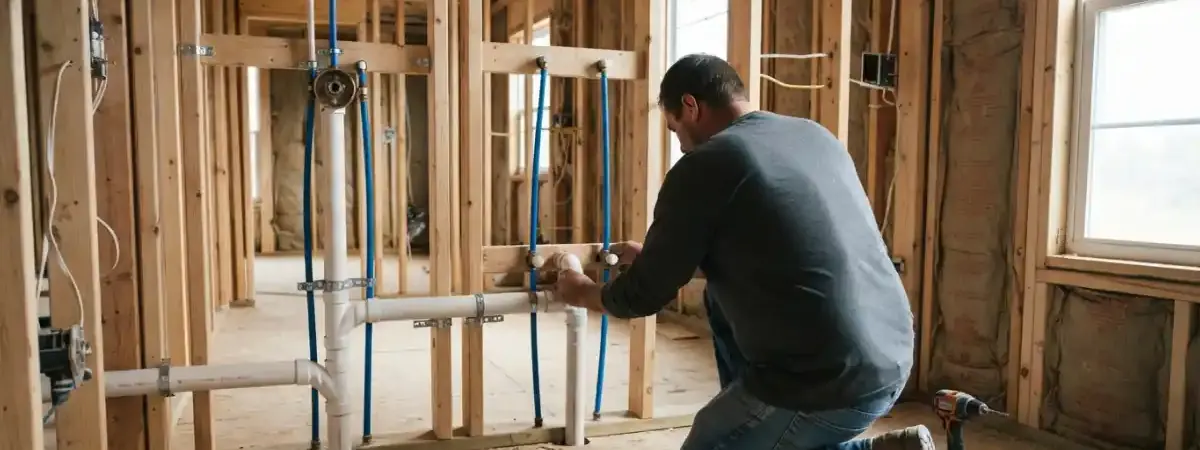
Push-to-connect fittings, often called by the SharkBite brand name, grip a pipe with a stainless steel ring of teeth and seal it with a rubber O-ring. You push the pipe in and it holds. Taking one off is a different matter, because the same grip that makes it fast to install makes it stubborn to remove without the right release.
This guide walks through the release in a way a careful homeowner in Elmwood Park, IL can follow, then covers pipe prep, reuse, where these fittings fail and where they do not belong. Where a repair needs a licensed plumber, we say so plainly.
Before you touch the fitting: what to confirm
Identify what the fitting is joining. Push-fit connectors are made for copper, CPVC and PEX, and some for polyethylene. If the pipe is corroded galvanized steel, a gas line or an unknown material, stop here. These fittings are not a repair for those, and a plumber should look at it.
Next, find out how the line is fed. A fitting on a branch off the water heater is a very different job from one on the line that feeds the whole house. Know where your main shutoff is before you start, and test it, because an old valve that will not close is the most common surprise.
- Turn off power or gas to the water heater before working near it, since draining a line can run the tank dry.
- Lay towels and a bucket under the fitting and keep a flashlight handy.
- Check whether the pipe is hot. Hot water lines can scald for a while after the heater shuts off.
Releasing the fitting in five steps
Depressurize and drain
Close the shutoff that feeds the line. Open the lowest faucet to drain the pipe and a high one to let air in, then wait until the flow stops. A fitting pulled under pressure can spray or blow the pipe out.
Position the release
Slide a disconnect tool or the plastic disconnect clip over the pipe and against the collet, the colored ring on the face of the fitting. The release must sit square, not at an angle.
Press the collet in evenly
Push the tool toward the fitting body. This presses the collet in and lifts the grip teeth off the pipe. Do not pry or twist with pliers, which bends the collet and often damages the pipe.
Pull the pipe straight out
While holding the collet in, pull the pipe straight back. Expect a little water from the line and the fitting. If it fights you, the pipe may be deformed or corroded, so stop and check before forcing.
Inspect both ends
Look at the pipe end for deep scratches, flats, rust or green corrosion and at the fitting for cracks or a pinched O-ring. Anything damaged means a new fitting and a trimmed pipe at the least.
Fitting stuck or leaking after you tried?
Stop pulling on it and call. Our licensed plumbers can release it, replace it and check the lines around it.
Pipe prep: cut, deburr and mark the depth
The grip teeth score the pipe, so the last inch or so of a removed pipe is usually scarred. Cut it back past the scratches with a tubing cutter, which leaves a clean square end. A hacksaw leaves a ragged cut that can slice the new O-ring during insertion.
Deburr the inside and outside edge with a deburring tool or fine file. Burrs are small but they are the most common reason a push-fit joint weeps. Wipe the end clean and check that it is round and smooth.
Then mark the insertion depth. Most fittings include a depth gauge, or you can use the depth chart for the fitting size. Pencil a line on the pipe, push the pipe in until the line meets the collet, and give it a gentle tug to confirm it grabbed. A joint that stops short of the mark has not seated.
PEX needs a stiffener
A stainless insert goes inside a PEX tube end so the O-ring has something firm to seal against. Skipping it is a classic cause of slow leaks.
Where push-to-connect belongs and where it does not
These fittings are useful in the right place. The pattern below is general plumbing practice, and codes and local rules vary, so check with the Village building department for anything beyond a small repair.
| Location | General view | Why |
|---|---|---|
| Accessible basement branch line | Reasonable for a repair | You can see and reach it, so a drip is found early |
| Behind a wall or ceiling | Poor choice | A slow leak can run for months before anyone notices |
| Buried or under a slab | Not appropriate | Soil, movement and no access make failures costly |
| Near a water heater flue or hot surface | Use with care | Radiant heat can age the O-ring, so check the fitting's temperature rating |
| Gas piping | Never | These fittings are made for water, not fuel gas |
| Corroded or galvanized pipe | Not appropriate | The grip needs a clean, round, smooth pipe surface |
How a push-fit joint tells you it is failing
Failures are rarely dramatic. They start small, and a quick look can catch them.
A bead of water at the collet
Moisture that returns after you wipe it dry means the O-ring is not sealing.
Green or white crust
Mineral crust or green corrosion on a copper pipe near the fitting shows a slow leak.
A fitting that moves
If the pipe can be wiggled or pulled with light pressure, it never seated or the grip is worn.
Dampness on nearby framing
Stains below the fitting often show up before drips are visible. A leak detection visit can trace where the water starts.
A faint hiss under pressure
A fine spray or hiss means the seal is breached. Close the shutoff and call.
Not sure a push-fit belongs there?
Our plumbers can look at the run, say whether the fitting is sound, and replace it with a soldered or crimped joint when that is the better repair.
Can you reuse a removed fitting?
Some manufacturers state that their fittings can be released and reused if you use the correct disconnect tool and the O-ring and collet are undamaged. Others advise replacing them. The instructions printed for your specific model are the authority, so read them.
A reasonable rule of thumb is to reuse a fitting only if it came off cleanly on a pipe that is still sound, and replace it any time the pipe was scarred, the O-ring looks flattened or the joint has been wet.
Push-fit repairs in Elmwood Park homes: old pipe and permit habits
Elmwood Park homes have a median build year of 1955, and about 77 percent were built before 1970. That means a repair often meets older pipe, such as galvanized steel, that looks fine from outside and is rough or narrowed inside. A push-fit joint needs a clean round pipe end, so older lines often call for a different repair than a quick connector.
Before you replace more than a short section of pipe, call the Village building department, since what needs a permit differs from one job to the next. The Village follows the Illinois State Plumbing Code. Homeowners who do their own plumbing sign a hold harmless form, and inspections need two working days of notice.
If you would rather not take that on, we serve homes across the Village and into River Grove, and our service area page shows the neighboring villages. Our plumbers are licensed, and you can check any plumber's licence on the Illinois Department of Public Health lookup.
Sources: CMAP community data, Village of Elmwood Park licensing and permit pages, IDPH plumbing pages
Push-fit fitting questions we hear in Elmwood Park
Use the tool or the clip. Pliers crush the collet and can scar the pipe, which turns a clean repair into a pipe replacement. Disconnect tools are inexpensive and many fittings ship with a clip that works for that size.
The usual causes are a pipe end that was not cut square, a burr that nicked the O-ring, a pipe pushed in short of the depth mark or a scarred pipe surface. Cut back to clean pipe, deburr, mark the depth and try again with a new fitting.
Not necessarily. Codes and local rules vary, and many plumbers limit them to accessible spots. Ask the Village building department if you plan more than a small repair. Our plumbers will tell you plainly whether a soldered or crimped joint is the better choice for your job.
Often for the cold feed in an accessible spot, but be careful near a flue or a hot surface. Heat can age the O-ring, so check the temperature rating on the fitting and keep the joint away from the flue. If you are unsure, have a plumber look at it.
That is a poor choice. A leak behind drywall or under soil can run unnoticed for a long time. Concealed runs are usually better served by joints that are soldered or crimped and tested before they are closed in.
With many homes built before 1970, you will often find galvanized or scarred pipe where a quick connector needs a smooth, round pipe surface. If the pipe end looks pitted or flaky once the old fitting is off, stop and have a plumber cut back to sound pipe.
Call when the shutoff will not close, the pipe is corroded or deformed, the fitting is in a wall or on gas, water is spraying or you cannot get a dry joint after two tries. Turn off the water at the main valve while you wait.
Standards and sources: Work in Illinois follows the Illinois Plumbing Code (77 Ill. Adm. Code 890), and the Village of Elmwood Park building department applies those minimum standards locally. Licence guidance comes from the Illinois Department of Public Health, whose online lookup verifies any Illinois plumber.