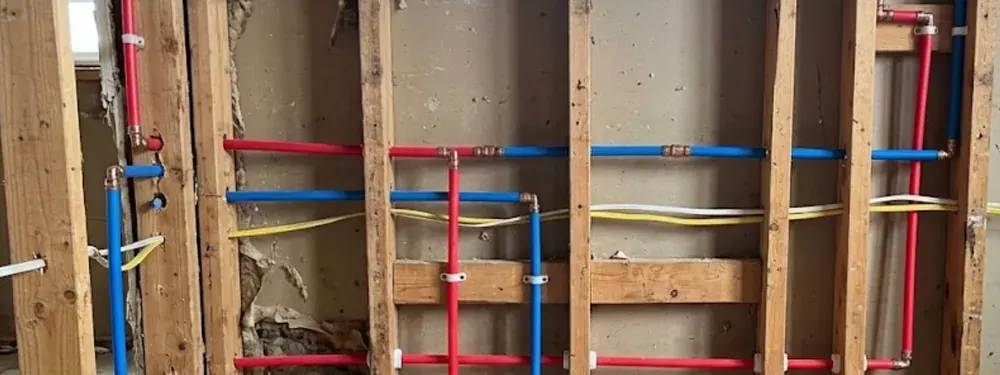
Ask three plumbers to price a whole-house repipe and you may get three numbers that look unrelated. That is normal, and it does not always mean someone is padding the bid. A repipe is less like buying a product and more like a small renovation that happens to run through every wall and ceiling in the house.
This guide explains what moves the price of a PEX repipe in Elmwood Park, IL, what a written quote should list line by line, and how to compare bids that were built differently. We do not name a number until our plumbers have seen the house, and the price is given before work starts.
Why two houses of the same size can price so differently
The pipe itself is the cheap part. What you are paying for is time: reaching every fixture, removing or abandoning the old lines, running new ones, making each connection, pressure testing the whole system and leaving the walls ready for a drywall trade. Anything that adds hours adds cost.
That is why square footage is a weak predictor. A compact two-story with stacked bathrooms can be faster than a sprawling ranch on a slab. Ask what the plumber actually saw in your house.
The cost drivers, one by one
Every repipe quote is some mix of the items below. Use the table as a map of where the money and the hours go.
| Cost driver | What happens on the job | Effect on the quote |
|---|---|---|
| Bathrooms and fixtures | Each fixture needs a supply run, a shutoff and a tested connection | More fixtures means more labor and parts |
| Number of floors | Lines must rise through framing or chases between levels | More levels means more access work |
| Access | Open basement ceiling versus finished plaster or a slab floor | Hard access adds the most time |
| Wall and ceiling repair | Holes cut to fish or replace pipe must be patched and painted | Often priced separately or handed to another trade |
| Permits and inspection | Village paperwork, fees and an inspector's visit | Varies by job, so ask the building department |
| Water service line | The pipe from the street to your meter and main shutoff | Left alone, tested or replaced, and each choice differs |
Want a repipe plan built around your house?
Our licensed plumbers look at access, floors and fixtures in person, then give you a clear price before any work starts.
Manifold or trunk-and-branch: the layout choice behind the bid
Manifold (home run) layout
- A central manifold sends a dedicated line to each fixture, a bit like a breaker panel for water.
- Fewer hidden fittings inside walls, since each run is one continuous length of PEX.
- Shutting off one fixture at the manifold leaves the rest of the house running.
- Uses more tubing and a bundle of lines to route, which can add labor in tight framing.
Trunk-and-branch layout
- Larger trunk lines carry water through the house, with smaller branches tee'd off to each fixture.
- Mirrors how most older homes were piped, so the routes are familiar.
- Uses less tubing and often fewer holes in framing.
- Pressure at one tap can dip when another opens if the trunk is undersized.
Neither layout is wrong. The quote should say which one is planned and why, because the choice changes both materials and hours.
Copper or PEX: where the trade-offs honestly sit
PEX is flexible tubing. It bends around corners and can be pulled through framing with fewer joints than rigid pipe, which saves labor in many houses. It copes with a cold snap better than rigid pipe because it can swell slightly, though it is not frost proof, and it must be kept out of sunlight, so it is not left exposed outdoors.
Copper is a proven material that many owners prefer. It is soldered joint by joint, which takes more skilled hours, and that is a main reason copper bids run higher. Ask the plumber why they recommend one for your house, and confirm with the Village building department that your choice is acceptable.
What an itemised repipe quote should list
A good quote reads like a scope of work. If a line below is missing, ask for it in writing before you compare totals.
Quote checklist
- Scope by fixture Every bathroom, kitchen sink, laundry hookup, hose bib and appliance line named, so you can see what is included.
- Pipe material and layout PEX or copper, manifold or trunk-and-branch, and where the manifold or trunk will sit.
- Shutoff valves Main shutoff and fixture stop valves, new or reused, written down rather than assumed.
- Water service line Whether the pipe from the street to the meter is left alone, tested or replaced, and who coordinates it. See our notes on water line repair.
- Access and repair Where walls and ceilings will be opened, and who patches, textures and paints.
- Permits and inspection Who pulls the permit, whether it is in the price, and which inspections to expect.
- Phasing and water-off time How the work is staged if you live there, and for how long the water is off each day.
Holding two quotes that do not match?
Tell us what each bid includes and our plumbers will help you work out what is missing from the cheaper one.
Comparing bids without being fooled by the bottom line
Lay the quotes side by side and compare scope before totals. A lower bid that leaves out wall repair, the permit or the shutoff valves is not a lower bid, it is a smaller one. Mark each line as included, excluded or unclear, then call the plumber about every unclear line.
Watch for vague allowances such as drywall as needed with no limit, and ask how extra work is approved before it is done.
Occupied-home phasing deserves its own question. Most families stay in the house during a repipe, so a sound plan keeps a working bathroom available and restores water at the end of each day. Ask how many days the water is off, in what blocks, and whether the new lines are pressure tested before the crew leaves.
Finally, check the licence. Illinois plumbers are licensed through the Illinois Department of Public Health, anyone can look up a plumber on the IDPH licence verification page, and the licence number must appear in plumbing advertising.
Repiping in Elmwood Park: older homes, permits and the street connection
The median home in Elmwood Park was built in 1955, and about 29 percent of homes date from before 1940. Many houses here are 50 to 90 years old, so original galvanized steel supply pipe is often found, sometimes mixed with copper from later updates. Galvanized pipe corrodes from the inside, which is why a house can have weak pressure and rusty water long before a pipe bursts.
Roughly half the housing is single-family, while two-flats, 3 to 4 unit buildings and bigger apartment buildings make up the rest. In a multi-unit building a repipe can involve risers that feed more than one apartment, so ask how other residents are affected and how shutdowns are scheduled.
Whether a permit applies depends on the scope, so the Village of Elmwood Park building department is the place to ask before a crew starts. Plumbers file a State licence, a liability insurance certificate and a bond with the Village, and permit fees are paid up front. If the plan touches the service line, Illinois law requires a call to 811 at least 3 days before any digging.
We also work just west of here, and neighbors in River Grove deal with their own village permit process, which is why we check the rules for each address. The service area page lists the nearby villages we cover.
Sources: CMAP community data, Village of Elmwood Park licensing and permit pages, JULIE (811), IDPH plumbing pages
Repipe quote questions from Elmwood Park homeowners
Often much less than people fear. Because PEX is flexible, plumbers can fish lines through existing cavities from the basement, attic or a few strategic access holes. Plaster walls, tile and cast iron tubs make this harder. The plumber should show you on a walk-through where holes are likely and who repairs them.
It depends on the size of the house and the layout, and it can range from a day or two on a small home to a week or more on a large one. The better question is how the work is phased. Many crews restore water at the end of each day so the household can cook, flush and wash.
One leak in an otherwise sound system is a repair job. Repeated pinhole leaks, rusty water, falling pressure and several failed joints point toward a repipe. A plumber can check pressure, inspect the pipe where it is visible and tell you honestly which side of that line your house is on.
Not unless the quote says so. The service line from the street to your meter is a separate scope, with its own digging and its own coordination. Ask for it to be listed as included, tested, left alone or replaced, so there are no surprises mid-job.
Yes. With a median build year of 1955 and many homes older than that, crews here often meet galvanized supply lines, plaster walls and older shutoff valves that will not close fully. That raises the odds of hidden repairs, so ask how the plumber plans to handle surprises behind walls.
That depends on the scope, so check with the Village building department. If one applies, the fee is paid before work starts and inspections need two working days of notice. The written quote should say who pulls the permit and whether it is priced in.
Standards and sources: Work in Illinois follows the Illinois Plumbing Code (77 Ill. Adm. Code 890), and the Village of Elmwood Park building department applies those minimum standards locally. Licence guidance comes from the Illinois Department of Public Health, whose online lookup verifies any Illinois plumber.