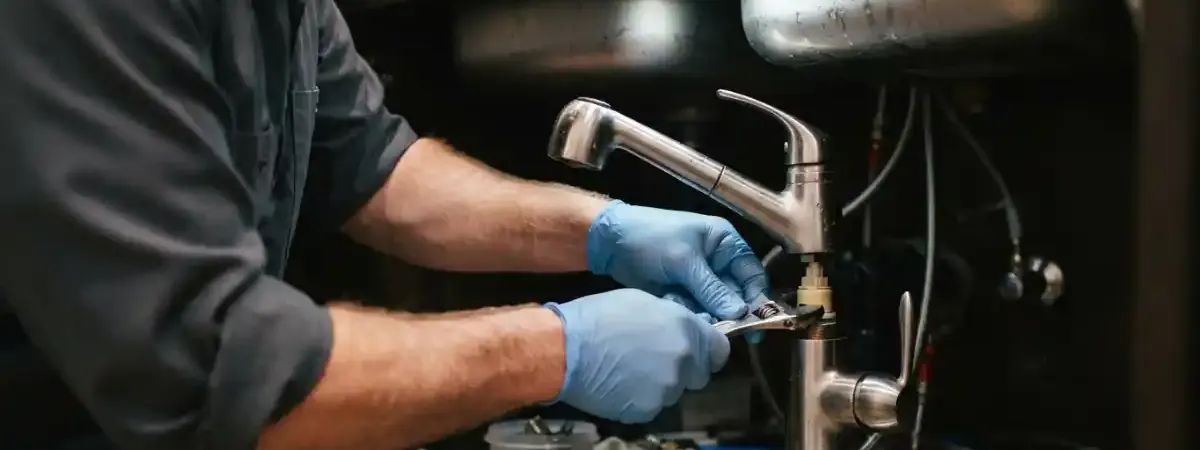
Dry the faucet with a towel. Then watch it for a few minutes. Where the first bead of water appears is the whole diagnosis, and it saves you from replacing parts that were never broken.
A kitchen faucet leaks in four places: under the sink, around the base, at the handle and at the spout. Each one has its own cause and its own fix. This guide takes them in order, then helps you decide whether the faucet deserves repair at all in your Elmwood Park kitchen.
Four leak locations and their usual causes
| Where it leaks | Likely culprit | Typical fix |
|---|---|---|
| Under the sink | Loose supply line nut, worn washer or a split hose | Tighten or replace supply lines and fittings |
| Around the base of the faucet | Worn O-rings or a loose mounting nut | Replace O-rings, snug the mount from below |
| At the handle | Worn cartridge, stem seal or loose handle | Replace the cartridge or seals |
| From the spout tip | Worn cartridge, valve seat or ball assembly | Rebuild or replace the internal valve |
| From a pull-out hose | Cracked hose or loose connector | Replace the hose or connector |
Notice that two of these are cheap, quick jobs and two require opening the faucet body. That is why finding the source first matters.
Start under the cabinet, where most leaks hide
Before you take the faucet apart, rule out the plumbing beneath it. A faucet that seems to leak from above sometimes has water running down from a supply connection and dripping off the base.
Under-sink inspection
- Dry every fitting. Wipe the shutoff valves, supply lines and connections with a paper towel.
- Run the water and feel along the lines. A damp towel or fingertip finds a drip faster than your eyes.
- Check the shutoff valves. Older valves can weep at the stem or the nut. Tighten gently, a quarter turn at a time.
- Inspect the supply lines. Braided lines can rust at the ends or kink. Replace any that look worn.
- Look at the cabinet floor. Staining, swelling or a musty smell means the leak has been going on for a while.
Water pooling in the cabinet right now?
Close the shutoffs under the sink, then call. Our licensed plumbers can trace the source and quote the work before starting.
Leaking at the base or handle: what is inside
Most modern faucets keep their working parts in a single cartridge or valve. A leak at the handle or base means something in that stack has worn, a seal, an O-ring, or the cartridge itself. Shutting the water off at the stops below the sink before you open anything is non-negotiable.
The usual routine is to remove the handle cap, loosen the set screw, lift the handle, and pull out the cartridge or retaining nut. Photograph each layer so reassembly goes in the right order. Some brands use a cartridge puller, a small specialty tool, to extract a stuck cartridge without damaging the body.
Do not force it. A faucet body that cracks because someone prised too hard has become a replacement.
Cartridge, ball and ceramic disc valves in plain terms
Faucets control water with one of a few internal designs. You do not need to memorize them, but knowing which you have helps you buy the right part.
Cartridge or ceramic disc
- Single lever or two handles, smooth action
- Usually a sealed insert that replaces as a unit
- Ceramic discs resist wear but dislike grit
- Often the simplest repair if parts are available
Ball or older compression
- Ball designs use a rotating ball with springs and seats
- Compression stems squeeze a rubber washer to stop flow
- More small parts, so repair kits matter
- Older faucets may be hard to find parts for
Bring the old part to the supplier, or note the brand and model stamped on the faucet. Matching parts is half the battle.
Spout drips and low pressure from one common cause
A spout that keeps dripping after the handle is off is usually a worn cartridge or valve seat. A spout that sprays weakly or sideways is often a clogged aerator, the small screen on the tip. Unscrew it, rinse out the debris and soak it in vinegar if mineral crust has formed.
If cleaning the aerator does not fix the flow, and a new cartridge does not stop the drip, the faucet body itself may be pitted or worn. At that point, replacing the faucet beats repeated repairs.
Repair parts not matching, or faucet beyond saving?
Our plumbers can swap a cartridge or replace the whole faucet and haul away the old one.
Repair or replace: a quick decision aid
| Situation | Lean toward | Why |
|---|---|---|
| Newer faucet, one worn cartridge | Repair | A single part usually restores it |
| Corroded body or cracked spout | Replace | The housing cannot be fixed |
| Parts discontinued | Replace | Chasing parts wastes time |
| Repeated leaks over a short time | Replace | Underlying wear is widespread |
| Hard to turn, pitted finish, low flow | Replace | The valve and body are tired |
If the faucet is also leaking where it joins the countertop, or the sink itself is cracked, a visit from our faucet repair team can sort out both.
Hidden leaks that look like a faucet problem
A cabinet that stays damp after you fixed the faucet may have another source. Supply stops, a dishwasher connection, the drain trap and even condensation on cold pipes can be responsible. If you cannot find the drip or the damage keeps returning, a professional leak detection visit uses moisture meters and listening tools to trace water behind walls and under floors.
Never ignore soft cabinet bottoms or mold smells. Constant dampness rots wood and invites pests, so a small leak left for weeks costs more than the faucet.
Faucet leaks and your water in Elmwood Park
Tap water here is Chicago's Lake Michigan water, bought by the Village, chlorinated and pumped to homes. Crust building up around an aerator or faucet base points to minerals, but we cannot cite a hardness figure, so test your tap or read the Village's published water report.
The pipe feeding your kitchen also matters. The Village has been mapping what its service lines are made of for state lead-line rules, and it wants owners and tenants to fill in its material inventory form. If a contractor ever proposes swapping only a piece of a service line, ask questions, since state law generally bars partial lead line replacement.
Extreme cold can freeze pipes, as the county hazard plan notes, so a kitchen sink on an exterior wall deserves a watchful eye. Our service area page shows where we work, and the River Grove plumber page covers the village next door.
Sources: Village of Elmwood Park water quality report and lead service line page, Illinois EPA and IDPH lead service line rules, Cook County hazard mitigation plan annex
Kitchen faucet leak questions
The hot side often has a worn seal or cartridge section, since heat accelerates wear. Replacing the cartridge usually resolves it.
Yes. Use the small shutoff valves under the sink, which isolate just that fixture. If they will not close or they leak, call a plumber.
It can be. Water around the base can run into the cabinet and rot the countertop or the cabinet floor. Fix it early rather than wiping it up each day.
If flow is weak or sprays crookedly but nothing leaks, unscrew the aerator and look for grit or mineral crust. Rinse it and refit.
Usually yes. Supply lines are inexpensive and old ones can burst or weep. New lines are good protection against a flooded cabinet.
Start with the Village's yearly water quality report, then ask the Village about its service line material inventory if you want to know what your own pipe is made of.
Standards and sources: Work in Illinois follows the Illinois Plumbing Code (77 Ill. Adm. Code 890), and the Village of Elmwood Park building department applies those minimum standards locally. Licence guidance comes from the Illinois Department of Public Health, whose online lookup verifies any Illinois plumber.