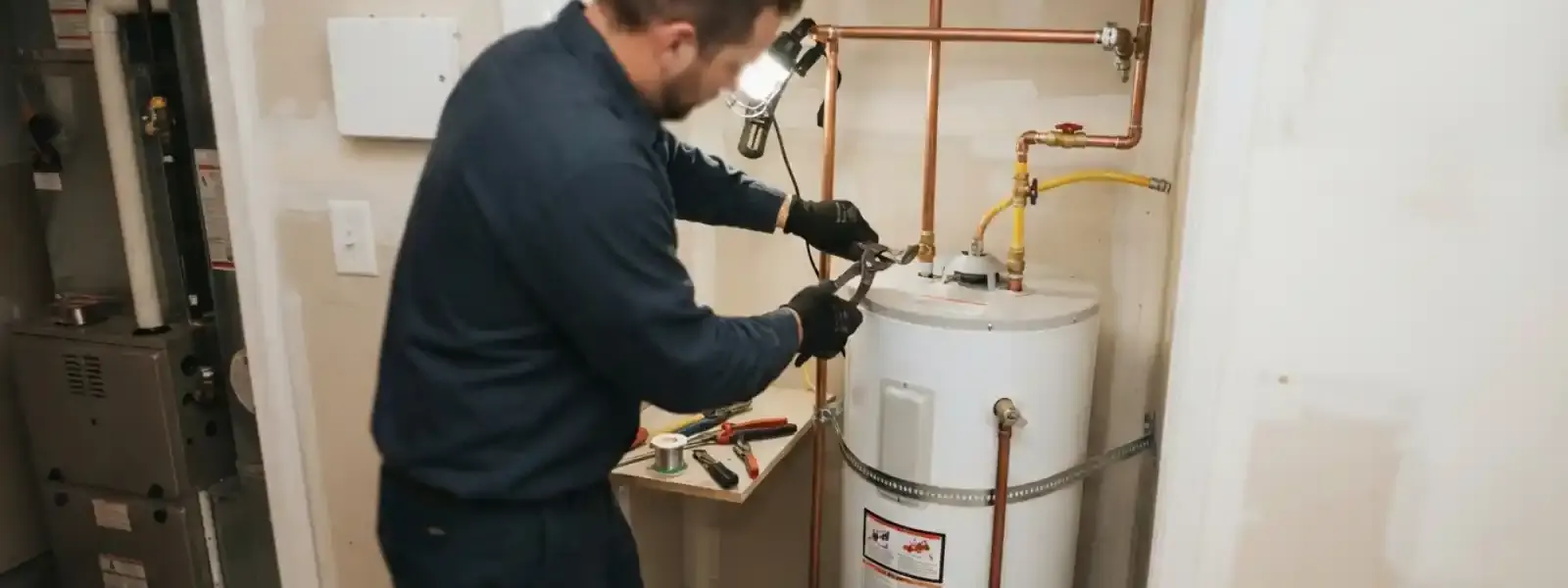
The shower starts hot, fades to warm within a couple of minutes, and the second person in line gets cold water. The tank is not leaking and nothing looks wrong. On an electric water heater, that pattern very often points to a burned-out heating element.
An element is a replaceable part, a bit like a heating coil on an old stove, that sits inside the tank and warms the water directly. Swapping one is a legitimate homeowner-level repair in Elmwood Park, but only if you respect the electricity and the water. This guide walks through both, and tells you plainly when to hand it to a licensed plumber.
Symptoms that point to a bad element
Most electric tanks carry two elements, an upper and a lower, and each one fails in a different way. Knowing which symptom you have narrows the guess before you open anything.
Lukewarm water, never fully hot
A dead upper element often leaves the tank unable to bring the top layer of water up to temperature.
Hot water runs out fast
If the lower element has failed, only the top portion of the tank heats, so you get a short burst of hot water and then cold.
Breaker trips or resets
A cracked element that leaks current to the tank wall can trip the breaker. Treat this one as an electrical fault first and a plumbing problem second.
Water takes forever to recover
A tank that once reheated in a reasonable stretch now needs hours. Weak or scaled-over elements are a common reason.
A rumbling or popping tank
Heavy sediment around the lower element can cause noise and shortens element life. Flushing often explains the sound.
None of these prove the element is at fault. A failed thermostat, a tripped high-limit reset button or a dead breaker can look the same. That is why the test comes before the purchase.
Confirm you own an electric heater before anything else
Gas water heaters have no heating elements at all. They warm water with a burner at the bottom of the tank and vent exhaust through a flue. If you see a gas line, a pilot or burner door and a vent pipe above the tank, this guide does not apply to you, and the water heater repair page is the better starting point.
An electric tank has a heavy cable entering the top or side, usually through a metal conduit, and one or two small rectangular access panels on the side of the jacket. Check the data label on the tank too. It lists the voltage and element wattage you will need at the supply counter.
Electrical safety comes before every other step
Water heaters run on household power strong enough to cause serious injury. Switch the dedicated breaker off, then use a non-contact voltage tester at the element terminals to confirm the power is truly dead. A breaker label can be wrong, and some homes have a second shutoff nearby.
If you cannot identify the correct breaker, if the panel looks scorched or crowded, or if you do not own a tester, stop here. Do not guess. A licensed electrician or plumber can do this part with the right instruments.
Not comfortable working near a live panel?
A licensed plumber can test the circuit and swap the element for you, with the price explained up front.
How the replacement goes, from shutoff to refill
Kill power and prove it
Switch off the breaker, remove the access panel and insulation, and test every terminal with a voltage tester. Only then touch a wire. Photograph the wiring so you can reconnect it exactly.
Close the cold supply and drain the tank
Shut the cold water valve at the top of the tank, attach a garden hose to the drain valve at the bottom, and run it to a floor drain. Open a hot faucet upstairs so air can enter and the tank empties. Hot water can scald, so let the tank cool first.
Remove the old element
Disconnect the two wires, then use an element wrench, a deep socket made for this job, to turn the element counterclockwise. A stuck element can need steady pressure.
Fit the new element
Match the voltage and style listed on the tank label. Seat a new gasket, thread the element in by hand, then snug it with the wrench. Some elements use thread sealant instead of a gasket, so follow the package.
Refill before you restore power
Close the drain, open the cold valve, and leave the hot faucet open until water runs steadily with no sputtering air. Check the new element for drips. Only after the tank is completely full do you reattach the cover and switch the breaker back on.
That last step is the one people skip. An element energized in an empty or half-empty tank burns out within seconds, and you will be buying another.
Reading a multimeter test without guessing
With the power proven off and the wires removed from the element terminals, a multimeter set to resistance or continuity shows what the element is doing. Test across the two terminals, then from one terminal to the metal flange.
| What you test | What you see | What it usually means |
|---|---|---|
| Across the two terminals | A small, steady resistance reading | The element coil is intact |
| Across the two terminals | No reading or an open circuit | The coil is burned through, replace it |
| Terminal to metal flange | Any reading at all | The element has a ground fault and can trip the breaker |
| Terminal to flange | No reading | Insulation is holding, good |
| Both elements fine | Normal readings everywhere | Suspect the thermostat or high-limit switch next |
Compare the numbers against the wattage and voltage on the tank label, or ask the supplier for the expected range. If the readings confuse you, that is a sign to call, not to push on.
Signs the tank is the problem, not the element
A new element is worth trying on a heater that is otherwise healthy. It is not worth trying on a tank weeping from the bottom seam or one with rust-colored water at the drain.
A tank that leaks through its shell cannot be repaired. If you see moisture under the jacket or a pooling floor, read about water heater replacement before spending another evening on parts.
When to stop and call a plumber
Put the tools down and make a call in any of these situations.
- The breaker trips again right after a new element goes in.
- You find melted insulation, burned wire ends or a discolored terminal block.
- The element will not budge and you are leaning hard on the wrench.
- Water seeps from the element flange after you refill and tighten.
- The tank shows rust streaks, bulging or a wet floor around the base.
- The temperature and pressure relief valve is dripping or discharging.
Scalding is the other hazard. Common guidance is a thermostat setting of about 120 F, because higher settings raise burn risk for kids and older relatives. Wiring or thermostat changes beyond a simple swap belong to a licensed professional.
Element swapped and still no hot water?
Our plumbers can trace thermostats, high-limit switches and wiring, and tell you honestly whether the tank is worth saving.
What Elmwood Park homeowners should know before opening the tank
The water in your tank is Lake Michigan water the Village buys from Chicago and pumps to homes. We cannot quote a hardness figure for it, so read the Village's yearly water quality report or test your own tap. Mineral build-up feeds the sediment that smothers a lower element, which is why some heaters need more attention than others.
Most homes here are 50 to 90 years old, and many buildings are two-flats or small apartment buildings. In a shared building, confirm which unit's panel and breaker actually feed your heater before you touch anything. If you rent, call the owner rather than opening the tank yourself.
Whether a tank or element job needs paperwork depends on the work, so a short question to the Village building department settles it. The Village's plumbing permit form does list water heaters. Any plumber you hire should be able to show a State licence, and the Illinois Department of Public Health lookup verifies it. We also take these calls in River Grove, and the service area page lists the other villages we cover.
Sources: Village of Elmwood Park water quality report and licensing and permit pages, CMAP housing snapshot, IDPH plumbing licence page
Heating element questions answered
Look for a thick electrical cable entering the tank and small access panels on the side. A gas unit has a gas line, a burner compartment near the bottom and a flue pipe rising from the top. Gas heaters have no elements.
You can, but the other one is usually the same age and has seen the same wear. Many people replace both while the tank is already drained, which saves a second drain-down later.
The usual cause is power reaching the element before the tank was full. The element is designed to sit submerged. Air around it overheats it in seconds. The second most common cause is the wrong voltage.
Yes. Sediment piles up around the lower element and insulates it from the water, which makes it run hotter and fail sooner. A periodic flush through the drain valve is simple maintenance, and our repair team can show you the routine.
It can be, with a breaker shutoff, a voltage tester and patience. If you feel unsure at any point about the electrical side, a licensed plumber or electrician is the safer route, and we give a clear price before work starts.
Look on the Village's Public Works water page for the yearly Consumer Confidence Report. It is worth reading before you blame your tank for scale.
Standards and sources: Work in Illinois follows the Illinois Plumbing Code (77 Ill. Adm. Code 890), and the Village of Elmwood Park building department applies those minimum standards locally. Gas smell guidance comes from Nicor Gas: leave the building, then call the gas utility and 911 from outside.