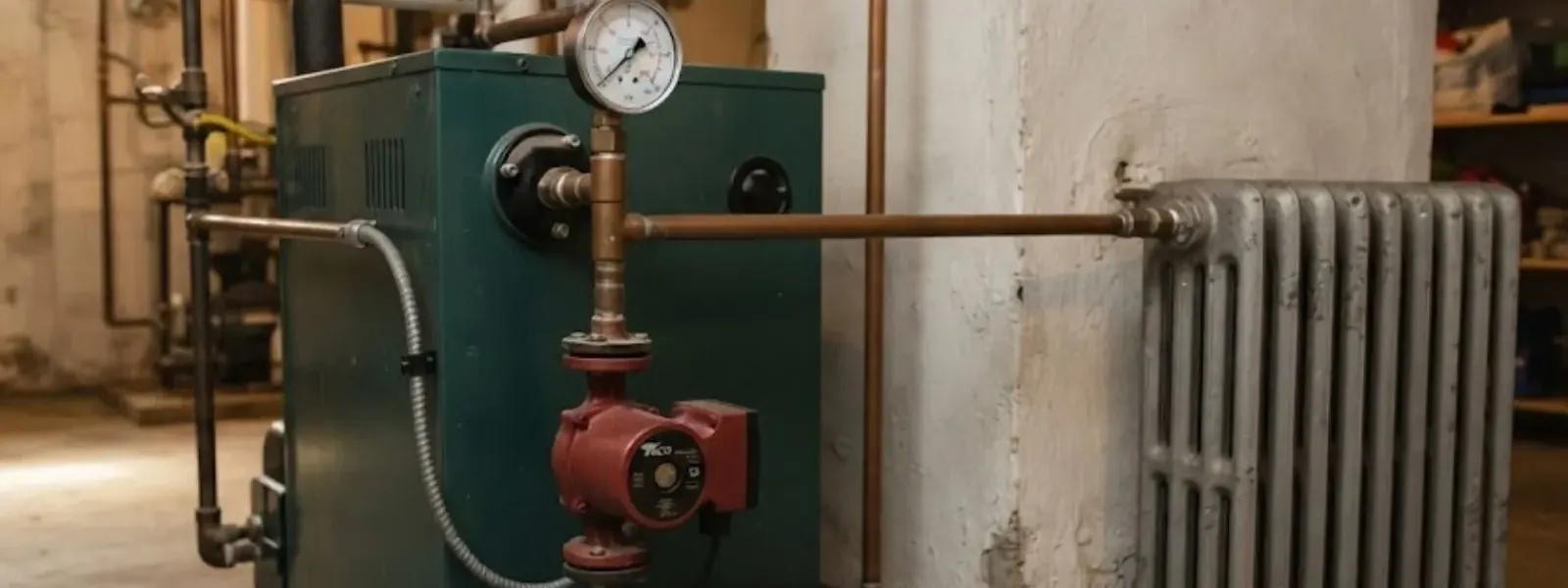
The house is cold, the radiators are lukewarm at best, and the boiler in the basement is either silent or running without delivering heat. Before you pick up the phone, a short list of checks can tell you whether this is a quick fix or a job for a professional.
Many older homes use a boiler instead of a forced-air furnace, and the two main types behave very differently. This guide walks through safe checks for steam and hot-water systems, then draws a hard line around the things you should not touch. Our plumbers in Elmwood Park cover the water side of a boiler, and we say plainly where other trades take over.
Cold house, working boiler: what the symptoms usually mean
Start by describing what you actually see and hear. The pattern narrows the cause faster than any single test.
No heat and no sound
The boiler may have no power, be locked out, or be waiting on a thermostat that is not calling for heat.
Boiler runs but radiators stay cold
Air may be trapped, a circulator may have failed, or valves may be closed. Steam systems may also have a stuck vent.
Some radiators hot, others cold
Often trapped air in hot-water systems, or a blockage or closed valve to one zone.
Banging or knocking
Water pooled in a steam pipe or air in a hot-water loop. Not always dangerous, but it should be looked at.
Water on the floor near the boiler
A leak at a valve, joint or tank. Shut off any obvious supply you can reach and do not touch wet electrical gear.
Steam or hot water: know which system you have
Steam boiler
- Heats water to make steam that rises through pipes to radiators.
- Radiators have a small air vent on the side, and a sight glass on the boiler shows the water level.
- Low water is a common cause of no heat or a shutdown.
- Radiator valves should be fully open or fully closed, never partway.
Hot-water (hydronic) boiler
- Heats water and sends it through pipes with a circulator pump.
- Radiators have a small bleed valve at the top, and the boiler has a pressure gauge.
- Trapped air and low pressure are common reasons for cold radiators.
- Baseboard convectors and radiant loops often share the same boiler.
Not sure which you have? Look at the radiators. A large valve on one end and a small vent on the other suggests steam. A small bleed screw at the top suggests hot water. The nameplate on the boiler often says too.
Ten minutes of checks you can do safely
None of these involve opening the boiler, touching the burner or relighting anything. Stop at any point where something smells, looks scorched or feels beyond what you are comfortable doing.
Work down this list in order
- Thermostat: Set it well above room temperature, check the mode says heat, and replace batteries if it has them.
- Power: Look for the boiler switch, often a plain light-switch style box near the stairs or on the unit, and check the breaker.
- Pressure gauge (hot-water systems): Compare the reading with the normal range printed on the manufacturer's label. A reading far below it can stop heating.
- Water level (steam systems): Check the sight glass against the marking on the boiler. If it looks empty, do not add water unless you know the procedure.
- Radiator valves: Make sure each valve is fully open. Steam valves left partway can hiss, spit or stay cold.
- Leaks: Look at the floor and at joints, valves and the relief valve. Dampness or rust stains deserve a call.
Tried the checks and still cold?
Our licensed plumbers can look at the water side of your boiler. Call the 24/7 line and describe what you see.
Bleeding air from hot-water radiators
If the top of a radiator stays cold while the bottom is warm, air is probably trapped inside. Turn the heating off for a bit so the pump is not pushing water around, place a rag and a small container under the bleed valve, and open it a quarter turn with a radiator key or a small flat screwdriver.
You will hear a hiss. Close the valve the moment a steady stream of water appears. Then check the pressure gauge again, because bleeding air lets some water out and the system may need topping up. Adding water is a step many homeowners prefer to hand to a plumber.
Do not bleed steam radiators the same way. Their vents work differently, and opening one can release hot steam. If a steam radiator is cold, check the vent and the valve, and call for help if neither explains it.
Stop and leave: gas smell, CO alarm, fumes
If you smell gas, leave the building immediately. Do not flip switches or use a phone inside. From outside, call the gas utility and 911. Nicor Gas serves Elmwood Park, though some addresses may use a different utility, so check your bill.
A carbon monoxide alarm that sounds means the same thing: get everyone outside, then call 911. Never relight a pilot you do not understand, never reset a boiler repeatedly after it locks out, and never ignore soot, scorching or a flue pipe that has come loose.
Who fixes what: plumber, heating contractor, gas utility
Boiler work spans trades. We would rather say that clearly than send the wrong person to your door.
| Problem | Likely trade | Notes |
|---|---|---|
| Leaking valve, fitting or pipe | Plumber | Our plumbers handle the water side |
| Low or high system pressure, expansion tank | Plumber | Pressure and tank checks |
| Failed circulator pump | Plumber | Replaced with the loop drained and isolated |
| Burner, ignition, flue or combustion issues | Licensed heating contractor | May need combustion testing |
| Gas smell or suspected gas leak | Gas utility and 911 | Leave first, then call |
Water leaking from the boiler?
Do not wait for it to get worse. Call us and our plumbers will check valves, fittings and pressure, and tell you the price before work starts.
When frozen pipes make a cold house colder
In severe cold, the heating loop is not the only thing at risk. Pipes in an unheated basement, crawl space or outside wall can freeze, and a frozen pipe can split. If your boiler is down during a hard freeze, keep the house as warm as you can and open cabinet doors on exterior walls.
If a pipe has burst, shut off the main water valve and call us right away. Our burst pipe repair team deals with winter breaks regularly. For a boiler that has stopped but is not leaking, our boiler repair page explains what we handle on the water side.
Heating in Elmwood Park's older homes
The median home in Elmwood Park dates to 1955, and about 29 percent were built before 1940. Houses of that age often have original piping and radiators, so a boiler problem may involve very old metal pipes as well as the boiler itself. Treat any unfamiliar corrosion or weeping joint as a reason to call.
Cold here can be severe. O'Hare reached minus 23 degrees Fahrenheit on January 30, 2019, the coldest in 34 years, and the county hazard plan notes frozen pipes during extreme cold. Illinois plumbing code sets minimum water service depth at 36 inches or local frost depth, whichever is greater, but interior pipes still freeze in unheated spaces.
Our office is on Grand Avenue, and we also serve neighbors in River Grove. See the River Grove plumber page or the full service area. If a boiler is being replaced, the Village building department can tell you what paperwork applies to your job.
Sources: NWS Chicago, Cook County hazard mitigation plan, CMAP community data snapshot, Nicor Gas safety guidance
Boiler heating questions from Elmwood Park homeowners
Common causes are trapped air, a failed circulator, closed valves, or low water or pressure. Check the thermostat and valves first, then call if the radiators stay cold.
It depends on the system, so check the manufacturer's label for the normal range. A reading far outside that range deserves a professional look.
Only if you fully understand the procedure for your specific boiler. If the pilot keeps going out, or you smell gas, leave and call the gas utility and 911.
Our plumbers cover the water side: leaks, pressure, circulators, valves and expansion tanks. Burner and combustion work may need a licensed heating contractor, and we will tell you if that is the case.
Yes, if heat stops during a hard freeze. Cold pipes in unheated areas can freeze and split, so keep the house as warm as possible and shut off water if a pipe breaks.
Many older homes were built with boilers and radiators. The median home in Elmwood Park dates to 1955, so original heating equipment or its replacement is common to find in the basement.
Get everyone outside and call 911 from outside. Do not go back in to investigate or reset anything.
Standards and sources: Work in Illinois follows the Illinois Plumbing Code (77 Ill. Adm. Code 890), and the Village of Elmwood Park building department applies those minimum standards locally. Gas smell guidance comes from Nicor Gas: leave the building, then call the gas utility and 911 from outside.